


The following is a condensed summary of our new policy report: “Sensible sports betting: A policy framework.”
Sports Betting’s Rapid Expansion
Eight years ago, sports betting was effectively illegal outside Nevada. Today, Americans legally wager more than $150 billion annually, mostly on their phones.
Emerging evidence links legalization and frictionless mobile gambling to reduced savings and increased financial distress, with larger effects among young men and financially vulnerable households. Public attitudes are shifting: 43% of Americans now say legal sports betting is bad for society, up from 34% in 2022. The shift is sharpest among young men, rising from 22% to 47% over the same period, according to Pew.
So what should be done?
Beyond the Binary
The debate has split into two camps.
Industry proponents argue that legalization generates tax revenue, entertains users, and engages sports fans. It brings gambling aboveboard, away from bookies and unregulated offshore operators who don’t pay taxes or protect consumers. Advocates don’t deny that some people are harmed but promote “responsible gambling” tools that let bettors set limits and seek help when needed.
Critics see social costs that outweigh any benefits. A casino in every pocket has fueled compulsive gambling and financial distress, primarily among young men, while pervasive advertising has normalized the activity. Responsible gambling tools, they argue, are ineffective window dressing compared to the addictive design and 24/7 allure of modern sports betting apps. Many would prefer an outright ban.
Both sides have elements of truth. Prohibition would push users towards unregulated, more dangerous alternatives. Yet responsible gambling tools are rarely used and only address harm after it occurs.
The core problem is misaligned incentives. States and sportsbooks both benefit when user losses increase, prioritizing revenue over public health. Competition drives operators toward ever more engaging products and VIP schemes, optimized to extract more from the heavy bettors who generate the vast majority of industry profits.
The path forward isn’t prohibition or the status quo. A more effective approach would establish friction points that slow dangerous patterns before they develop and guardrails that prevent the worst outcomes. We recently published a nine-part policy framework to lay out the building blocks of a sensible reform agenda. Here’s the distilled version:
Approaches to Reducing Harm
Voluntary self-control tools
Most responsible gambling tools are opt-in, and rarely used. Ensuring users are in control of their own play means building in friction before gambling starts, not after problems emerge. Deposit limits, maximum bet amounts, and session time-outs all become more effective when they’re on by default, so users can regulate themselves from the start.
Loss limits and affordability checks
A small share of bettors account for the vast majority of sportsbook revenue, and the vast majority of harm. Preventing catastrophic losses is the most direct way to reduce extreme financial distress. Regulations such as affordability checks for customers depositing large amounts can curtail damage before it spirals.
Safe platform design
Sportsbooks deploy the same design principles as social media and other tech platforms—reduced friction, variable rewards, push notifications, misleading design—all of which increase compulsive use, particularly among vulnerable users. Making legal platforms meaningfully safer than black market alternatives means regulating these features, such as by mandating separate wallets for sports betting and casino play, and banning reverse withdrawals.
Limits on bet types
Not all bets carry equal risk. In-play wagering, micro-bets on individual plays, and same-game parlays are the fastest-growing categories, and each carries unique risks for problem gambling. More research is needed to understand the effects of different bet types to prevent users from gambling out of compulsion instead of entertainment.
Limits on marketing
Gambling ads saturate sports broadcasts, normalizing the activity and fueling escalation—especially among young viewers. Promotional offers increase uptake among non-gamblers and relapse among those trying to quit. Restricting advertising that reaches youth and eliminating misleading framing are straightforward ways to minimize harm.
Responsible personalization
Sportsbooks have the behavioral data to detect problem gambling. But they can use it to maximize extraction. Algorithmic targeting designed to increase betting intensity should be prohibited; VIP programs that reward heavy losses should be restricted.
Tax rates that cover public costs
States currently earmark just 1 to 3% of sports betting revenue for prevention and treatment, far less than the public costs gambling generates. Effective regulation requires funding for treatment, enforcement, and independent research. Setting differential rates by product risk and dedicating more revenue towards specific goals are two ways to close that gap.
Information and awareness
Education alone won’t eliminate high-risk behavior, but combined with increased transparency, it can help bettors recognize warning signs before they escalate. Gambling literacy programs, standardized account statements showing net losses, and public dashboards tracking industry-wide patterns would give bettors and policymakers the information they currently lack.
Protecting sports and athletes
Betting-related harassment of athletes is widespread, integrity scandals have increased, and gambling has become nearly inescapable from the viewing experience. Banning player prop bets for college athletes, excluding users who harass players, and offering gambling-free broadcast options are all ways to preserve what draws people to sports in the first place.
The Policy Window is Open
Politicians across the aisle are souring on the status quo. For instance, Ohio’s Republican governor has publicly said he regrets signing the state’s sports betting bill, while Massachusetts Democrats have proposed serious consumer protections.
Young men are at the center of this story, as the heaviest users and the most financially harmed. The challenge for policymakers is to preserve consumer choice and recreation while reducing financial distress and harm. These nine approaches are a starting point.
Read the full report: Sensible sports betting: A policy framework
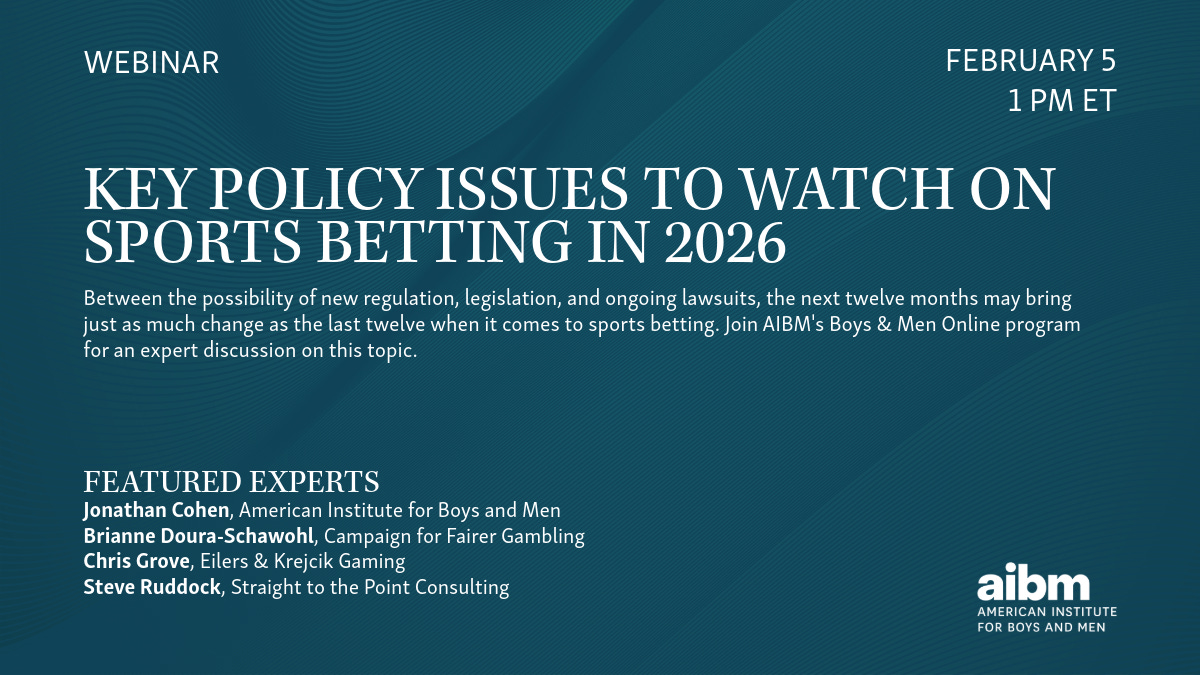
Please join us on Friday, February 5, at 1 pm ET for a discussion of the key policy issues, legal challenges, and industry trends shaping sports betting in 2026. We’ll be joined by Brianne Doura-Schawohl of the Campaign for Fairer Gambling, Steve Ruddock of Straight to the Point, and Chris Grove of Eilers & Krejcik Gaming.
Register here.
As a dad to young boys I think a lot about this. Thanks for sharing! I like the idea of self control tools being on by default
I know myself well enough that I seldom gamble and never on sports because I have compulsive spending issues. These sound like good ideas to me, especially a standard statement format and making the control tools opt-out.