

CTRL Panel
After reading Common Sense Media’s new report on gambling among boys aged 11-17—more on this soon—we reached out to some teachers to ask how gambling is showing up in their schools.
One teacher said students estimated that 70% of other senior boys place at least one bet per week, and mentioned one student who had bet 13k on college basketball this season. Another teacher described a high school junior whose parents are working with the school because he can’t stop gambling.
These anecdotes got me thinking about an anecdote from Harry Levant during a recent webinar on sports betting reforms by CASPR.
During a school presentation, Levant showed a DraftKings ad featuring Cam Wilder. Most of the 11th and 12th-graders didn’t know who he was, but the fifth and sixth-graders erupted when Cam Wilder’s picture went on the screen. Even if gambling starts to show up in high school, the groundwork is laid even earlier.

What’s next for sports betting in 2026? We’ll be hosting a webinar tomorrow (Feb. 5th) at 1 p.m. ET, with Brianne Doura-Schawohl (Campaign for Fairer Gambling), Chris Grove (Eilers & Krejcik Gaming), and Steve Ruddock (Straight to the Point Consulting). You can register here.

The Feed
Findings
Almost half of 17-year-old boys have gambled in the past year
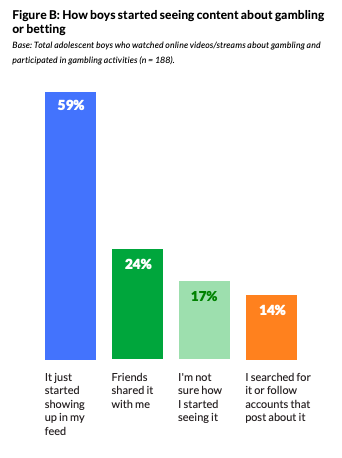
Common Sense Media’s new report finds that 36% of boys age 11-17 have gambled in the past year, with the highest among 17-year-olds (49%). Of those who gamble, the majority (59%) report that gambling-related content “just started showing up” in their feeds—suggesting that algorithms are driving discovery.
Porn “onset” research may be measuring the wrong thing
When does porn use begin? Researchers often use “age of first exposure” as if it were equivalent to “age began regularly using porn”. A recent paper by AIBM fellow Bailey Way shows why this can be misleading. Grouping users by age of first exposure and age of regular use, the study finds three profiles. Early engagers (67%) and late engagers (25%) both saw porn at around the same age (~14), but diverged sharply on when they became regular users (~18 vs. ~39).
A smaller, third group (7%) uses porn the least, are the most religious, and report more distress about porn usage than later engagers—consistent with moral incongruence mechanism (distress about use despite relatively low use).
Policy & News
Senate hearing on impact of screen time on kids
The Senate Commerce Committee convened researchers last month for a hearing on tech and mental health among youth. The committee was unusually united; after Democratic senator Ben Ray Luján urged congress to subpoena social media CEOs over their “damaging” products, Chair Ted Cruz responded that Luján was “preaching to the choir.” Cruz is a co-sponsor, along with Sen. Brian Schatz, of the Kids Off Social Media Act, which would restrict social media platforms for users age 13-and-under, and restrict addictive content for users under 17.
Addictive social media design on trial in K.G.M. case
Addictive social media design is now being tested in court. The plaintiff, identified as K.G.M., is suing over claims that features like recommendation algorithms, autoplay, infinite scroll, and notifications aren’t neutral “speech,” which would be protected by Section 230, but rather product mechanisms that drive compulsive use and worsen mental-health outcomes. Section 230 has long shielded platforms from liability for user-generated content. This case argues that shield shouldn't extend to the product features that determine how content reaches users.
If you’re interested in better understanding the case, we found the Bloomberg Law Podcast’s episode especially helpful.
Meta halts use of AI characters for teens
In a January 23rd blog post, Meta announced that they will no longer allow teens to access AI characters as they build “a new version of AI characters, to give people an even better experience.” The move follows growing concern about AI companion apps and their effects on young users, particularly around emotional dependency and social displacement. Meta did not offer an explanation for the sudden reversal, however. Teens will still be able to use Meta’s AI assistant.
Takes
Reflections on Taming Big Tech
The Niskanen Center published four essays on why Big Tech has proven so difficult to tame, and how a political movement could rise to the challenge. Each draws on historical comparisons to past social movements and technological upheaval. What’s most interesting, though, is where those analogies might fall apart.
Christopher Allbritton describes a “flywheel” effect, where companies grow by offering something genuinely valuable to users, before exploiting users for profit, then bankrolling the next company that users jump to. He worries we’re not equipped to address the modern version:
But what if the flywheel’s velocity has changed the math? Maybe the cycle now spins fast enough to outrun patient preparation. Maybe the platforms now so thoroughly control the online equivalents of union halls, where organizing might happen, that we can never quite prepare the ground.
If platforms control the very spaces where organizing against them would happen, how do you build a counter-movement?
Adam Garfinkle argues that digital addiction is less dramatic but more insidious than traditional vices:
for any practical purpose, all the elements of cyberaddictions are packed into an individual’s headspace, making them more insidious than conventional addictions even as they tend to be both less dramatic, less unhealthy in a manifest bodily sense, and — again — much less socially anomalous.
A new VICE documentary takes on sports betting
In their new documentary, Out of Bounds: The Sports Betting Boom, VICE examines sports betting’s rise over the last decade. Some of our highlights:
0:47:34: A particularly poignant moment from one of the three ASU students at the center of the documentary.
0:54:48: Isaac Rose-Berman on how sports betting companies rely on big losers as from a very small number of consumers.
1:22:12: David Hill on sports betting as a potential stepping stone to online casinos.
What else we’re reading
How to Bet on (Literally) Anything - New York Times
The sole federal regulator over prediction markets says it’s easing off - Business Insider
FanDuel Introduces “Play with a Plan:” A Research-Based Approach to Responsible Gaming - FanDuel
The App stores should remove online gambling apps - Recursive Adaptation
Which Young Men Are “All In” On Crypto? - Young Men Research Initiative
Pornhub Will Block New UK Users Starting Next Week to Protest ‘Flawed’ ID Law - WIRED
Kalshi in court over 19 federal lawsuits. What's the future of prediction markets? - NPR
Events & Funding Opportunities
*New* Friendship in the Screen Age: What is it, and How is it Changing? | February 12, 2026 | Online
International Conference on Gambling & Risk Taking | Las Vegas, NV | May 26-28, 2026
National Conference on Gambling Addiction & Responsible Gambling | Nashville, TN | July 22-24, 2026 | Call for presentations closed.
What did we miss this week? Do you have an upcoming conference or study we could feature in the next edition? Do you have a take on how to approach regulating big tech? Let us know at bmonline@substack.com, or shoot me a message here.
If you haven’t already, please subscribe to stay up to date on Boys & Men Online.
And share!