

CTRL Panel
A New York bill targeting harmful chatbot design features—rather than focusing on downstream harms—may signal a new trend in tech regulation for minors.
Last month, a N.Y. bill aimed at restricting unsafe chatbot features for minors (S9051)—crafted by Sen. Kristen Gonzalez with the Attorney General’s office—moved out of the Senate Internet & Technology Committee.
Much of the existing and proposed legislation around chatbots is focused on preventing the most dramatic harms—for example, by requiring platforms to take measures that prevent encouragement of self-harm and the generation of sexually explicit material. This bill, by contrast, would bar chatbots displaying behaviors that simulate companionship when interacting with minors—like use of first-person pronouns, or suggesting to the user that it is human.
The idea, basically, is to move upstream. Rather than catalogue every downstream harm, target the design mechanics that enable attachment and dependency in the first place. Whether or not it passes, S9051 could be an important bellwether for that approach.
The Feed
A 50-state scorecard for gambling policy…
The Center for Addiction Science, Research, and Policy (CASPR) has released scorecards evaluating states’ gambling policies. They offer the most points for not allowing iCasino and sports gambling apps, followed by strong restrictions like mandatory loss limits.
… and a 50-state scorecard for policies around childhood in the digital age
The policy team at the Anxious Generation has introduced the Childhood Index, a 50-state ranking evaluating how well states are protecting children online and supporting offline childhood. The index grades states on policies like phone-free school rules, age-verification requirements, and gubernatorial leadership. Utah and New York lead the pack, earning the designation of national leaders.
Writer and sex researcher Aella released results from her Big Kink Survey, a 970k-respondent self-report survey covering sexual preferences and experiences along with demographic variables. Alongside a data explorer tool, she’s also shared a subsample of the full dataset for download (with particularly sensitive responses redacted).
While she released a version re-weighted to better match population demographics, the dataset is still a convenience sample promoted through her own fairly niche audience—so the resulting bias likely isn’t entirely corrected by demographic controls.
That said, it’s a cool dataset worth exploring. For example, a 2020 paper by Aleksandar Štulhofer showed that non-consensual sexual behavior was predicted by callousness, but not past porn use. And with Aella’s much-larger sample, we can at least do the simplest non-causal check and see they’re positively correlated in her sample.
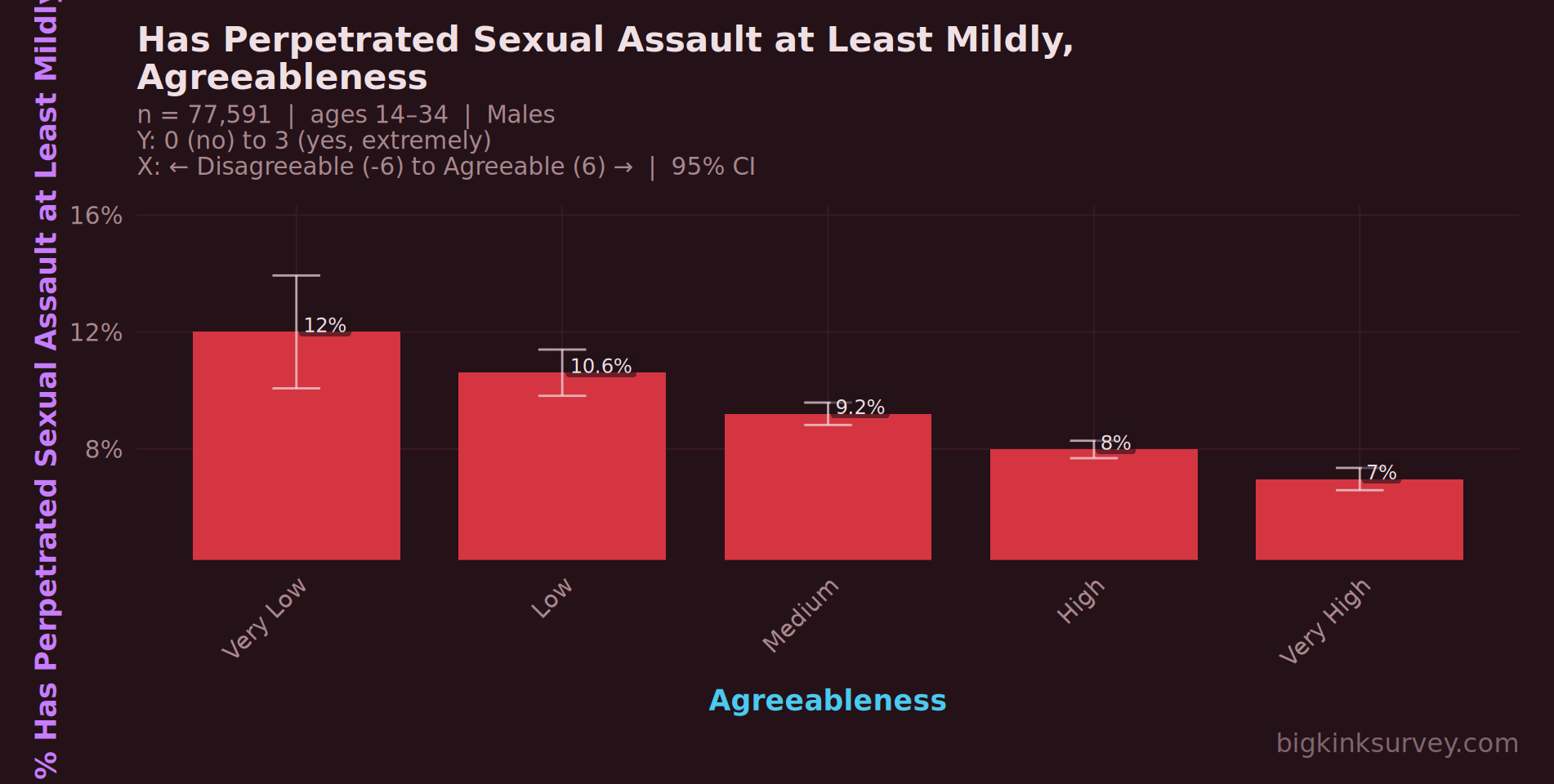
(Of course, this doesn’t imply causality, and it doesn’t incorporate porn use as a variable. That’d be a natural next step.)
Pew survey finds strong race and class angles to teen AI-use
A recent Pew survey finds that Black teens are about twice as likely as white teens to say they’ve used AI chatbots for emotional support/advice (21% vs. 8%), and Black parents are more comfortable with their children doing so (27% OK with emotional support vs 17% of White parents). This may reflect class differences: 30% of parents making below $30k report being okay with emotional support use, versus 18% of parents making >$75k.
Differing use rates could be a product of unequal access to emotional support, but it might also simply reflect different attitudes towards AI: Black teens are significantly more likely to be extremely or very confident using chatbots (37% vs. 23% of White teens), for instance.
Black and Hispanic adults are also especially likely to engage in sports betting, compared to white adults.
Surprising feelings about sports gambling
Two findings jumped out from a recent Sacred Heart University poll examining perceptions of sports gambling.
First, 53% of respondents affirmed that the sports gambling industry behaves completely or mostly responsibly, versus 31% who said the industry behaves somewhat or very irresponsibly. I’ll admit I’m surprised trust is this high, especially after recent high profile sports integrity scandals.
Second, when asked about preferred accessibility, respondents were roughly evenly divided between wanting sports betting more accessible (31%), less accessible (28%), and equally accessible (31%). Strikingly, the share who wanted sport betting less accessible (28%) was barely greater than the share who said sport betting should not be legal, period (27%). In this survey, at least, there is essentially no one who wants sports betting legal but more difficult to access.
An interview on violent porn and porn research
In an interview with Undark, psychologist Melissa de Roos discusses the proliferation of child sexual abuse material, links between violent porn and violent behavior, and the difficulty of researching porn. She touches on results from her recent paper showing that perceived realism mediates the relationship between violent porn and violent behavior:
Violent pornography, in and of itself, does not typically or necessarily lead to real-world sexual violence. You tend to need to have other ingredients present as well. Now, if you are watching something and you think, “Wow, that is insane, that is so not realistic,” you are going to be less likely to adopt that into your blueprint of how a relationship works or a sexual encounter works.
What else we’re reading
How strong is New York’s “illegal gambling” case against Valve’s loot boxes? - Ars Technica
Getting Global Age Assurance Right: What We Got Wrong and What’s Changing - Discord
We are all going to regret Kalshi - Dave Karpf
FTC declines to enforce a kids privacy law for data collected to verify users’ ages - The Verge
Age assurance as a spectrum: a risk-based approach from a European perspective - 5rights Foundation
Former Top Trump Official Is Going After Prediction Markets - Wired
Events & Funding Opportunities
*New* Online Gambling and The Public Health Movement: An International Symposium | Boston, MA | April 24th, 2026.
Movember Request for Proposal - Esports and Gaming Mental Health Awareness Training | Closes March 6th, 2026.
International Conference on Gambling & Risk Taking | Las Vegas, NV | May 26-28, 2026.
National Conference on Gambling Addiction & Responsible Gambling | Nashville, TN | July 22-24, 2026 | Call for presentations closed.
What did we miss this week? Do you have an upcoming conference or study we could feature in the next edition? What role do you think culture and policy should play in managing vice? Let us know at bmonline@substack.com, or shoot me a message here.
If you haven’t already, please subscribe to stay up to date on Boys & Men Online.
And share!