

CTRL Panel
This past week, I found myself at the annual meeting of the American Economic Association in Philadelphia. Across hundreds of talks and panels, I counted just one session on sports betting (shoutout to Matthew Brown’s “Do Sports Bettors Need Consumer Protection?”) and none on pornography, AI companions, or gaming (never mind digital addiction more broadly).
This got me thinking about the sort of questions I’d like to see economists tackle at next year’s meeting. Here’s my wishlist:
What does problem gambling look like over time? What are the different pathways into problematic use?
How do young NEETs—those not in education, employment, or training—spend their time online? Is it mostly gaming? Infinite scrolling? Or something else entirely?
Do the psychological factors that predict parasocial behavior also associate with the use of AI companions?
In a recent NYT op-ed, Julia Angwin described switching her iPhone to greyscale as if “an invisible cord had been severed.” What would happen if you made people switch? Would usage fall? Or would they adapt? And would any effects persist once greyscaling was turned off?
2026 is stacking up to be a big year for policy in our areas of focus—more on that below—and we’re hoping that (with your help) it’ll be a big year for research, too.
The Feed
Findings
Longitudinal evidence for the social transmission of problem gambling
A new longitudinal study tracking Finnish adults over eight waves examines the social transmission of problem gambling. When someone begins reporting that a family member has a gambling problem, their own gambling-problem score rises slightly. Strong family relationships (but not friendships) appear to diminish this effect.
Connections → Similarly, there’s evidence in the pornography literature that some “traditional” predictors—puberty and parental style—matter partly because they shape peer environments. Teens surrounded by peers who use porn are more likely to end up on higher-use trajectories (especially boys).
Girls on TikTok, boys on YouTube
A recent Pew survey finds that 24% of teen girls report using TikTok “almost constantly,” compared with 17% of boys; the pattern flips on YouTube, where 20% of boys (vs. 13% of girls) report near-constant use. The survey also reports substantial racial differences, with 37% of black teens reporting near-constant use versus 10% of white teens.
Policy & News
The Verge overviews the tech laws of 2026
The Verge published a useful roundup of tech laws scheduled to take effect in 2026 (barring legal challenges). If you’re tracking state-by-state policy changes, it’s a helpful summary.
Virginia social media time limits come into effect
As of January 1st, a Virginia law came into effect requiring social media platforms to use “commercially reasonable” age checks and default anyone under 16 to one hour per day, per app (unless a parent provides consent). Whether it actually will be enforced depends on Virginia’s Attorney General and the outcome of a pending federal lawsuit.
Mental health warnings for infinite feeds in NY
In late December, New York Governor Kathy Hochul signed a bill requiring social media platforms to show unskippable mental-health warning labels to young users when they encounter “addictive” features like autoplay and infinite scroll. California lawmakers have proposed a similar bill.
From our DMs:
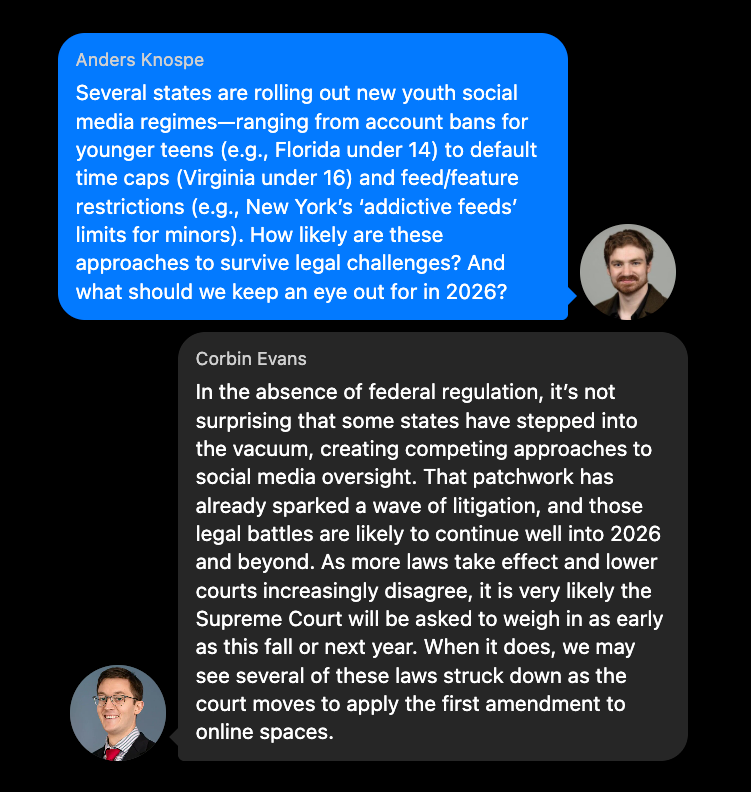
Takes
Reviewing the evidence on gaming for young boys
This recent article in Parents provides a helpful overview of the evidence on video games for boys, discussing the potential benefits (friends, socialization) and risks (addiction, exposure to predatory behavior).
Still, I’m hesitant to say anything about the effects of “video games” as a unified category. There are important differences between playing together versus alone, and evidence that some types of games (in particular, action video games) may have special benefits for cognitive development.
What else we’re reading
In 2026, We Are Friction-Maxxing - Kathryn Jezer-Morton in The Cut
China issues draft rules to regulate AI with human-like interaction - Reuters
74 suicide warnings and 243 mentions of hanging: What ChatGPT said to a suicidal teen - The Washington Post
One more night in a ‘sober house’ for sports bettors - The Washington Post
Prediction Markets and the ‘Suckerifcation’ Crisis, With Max Read - The Atlantic
Prediction markets are booming. How to tax winnings is anyone’s guess - CNBC
5 Ways The Prediction Market Experiment Ends - Steve Ruddock
Everything is gambling now — The Vergecast
Events & Funding Opportunities
FTC Workshop on Age Verification Technologies | DC | Jan 28, 2026
International Conference on Gambling & Risk Taking | Las Vegas, NV | May 26-28, 2026 | Call for abstracts closes January 23rd.
National Conference on Gambling Addiction & Responsible Gambling | Nashville, TN | July 22-24, 2026 | Call for presentations closed.
*New* Young Futures Awards Nomination | Nominate someone who is “driving youth wellbeing in a tech-filled world.” | Closes January 21st.
What did we miss this week? Do you have an upcoming conference or study we could feature in the next edition? Are you a researcher studying how NEETs spend their time online? Let us know at bmonline@substack.com, or shoot me a message here.
If you haven’t already, please subscribe to stay up to date on Boys & Men Online.
And share!