

CTRL Panel
Last Friday I watched the Knicks clinch a 105-104 win from outside a bar in Ridgewood, NYC. As a bandwagon Knicks fan, I was happy. But not as happy as our patio neighbor, an affable college freshman who had a $2,000 Kalshi bet riding on the game. When I asked how long he’d been a Knicks fan, he replied he wasn’t really one.
These days you don’t need to be into sports to gamble on sports. And if sports betting isn’t your thing, you can gamble on the next Los Angeles Mayor or the daily temperature in Phoenix. As we’ve covered before, feelings of financial precarity have made risky bets feel rational to many young people. Gambling—and high-risk investing—is everywhere.
Join us next week at 1:00pm ET June 18th, 2026 for a webinar on the gamblification of everything. New York Times journalist German Lopez will moderate the conversation, featuring author Kyla Scanlon, Fanatics CEO Matt King, and AIBM’s Sports Betting Policy Lead Jonathan Cohen. Register here.
The Feed
Sports betting tax design affects betting behavior
A new working paper by Matthew Brown and Jeffrey Ohl looks at how sports betting tax design matters. They find that when taxes are levied on sportsbook revenue—as most states do—costs fall on firms, who respond by cutting back on advertising and promotional offers rather than raising the price or worsening odds. This is effective at raising revenue, but doesn’t significantly reduce betting.
By contrast, when taxes are tied more directly to each bet—as with Illinois’s per-wager tax—sportsbooks are more likely to pass costs through to bettors through fees or higher minimum bets, which more directly discourages betting.The paper also finds that sportsbook advertising increases betting, largely by inducing more people to make deposits rather than by driving existing bettors to deposit more.
Age-verification modestly reduces porn site use
We’ve covered the early evidence on age verification before—in particular that these laws drive at least some traffic from compliant to non-compliant sites. This paper, also by Matthew Brown—along with AIBM research fellow Emily Davis and Devin Pope—shows the user side of the equation, albeit among adults only. They find that most adult-site use persists despite the laws. For every 100 hours previously spent on top adult sites, about 50 were already on noncompliant sites, 30 continued through VPN-style circumvention, 10 shifted from compliant to noncompliant sites, and 10 disappeared.
These estimates are for adults only, so they shouldn’t be read as a test of whether the laws reduce minors’ access.
Young people’s AI use falls into distinct social and emotional clusters
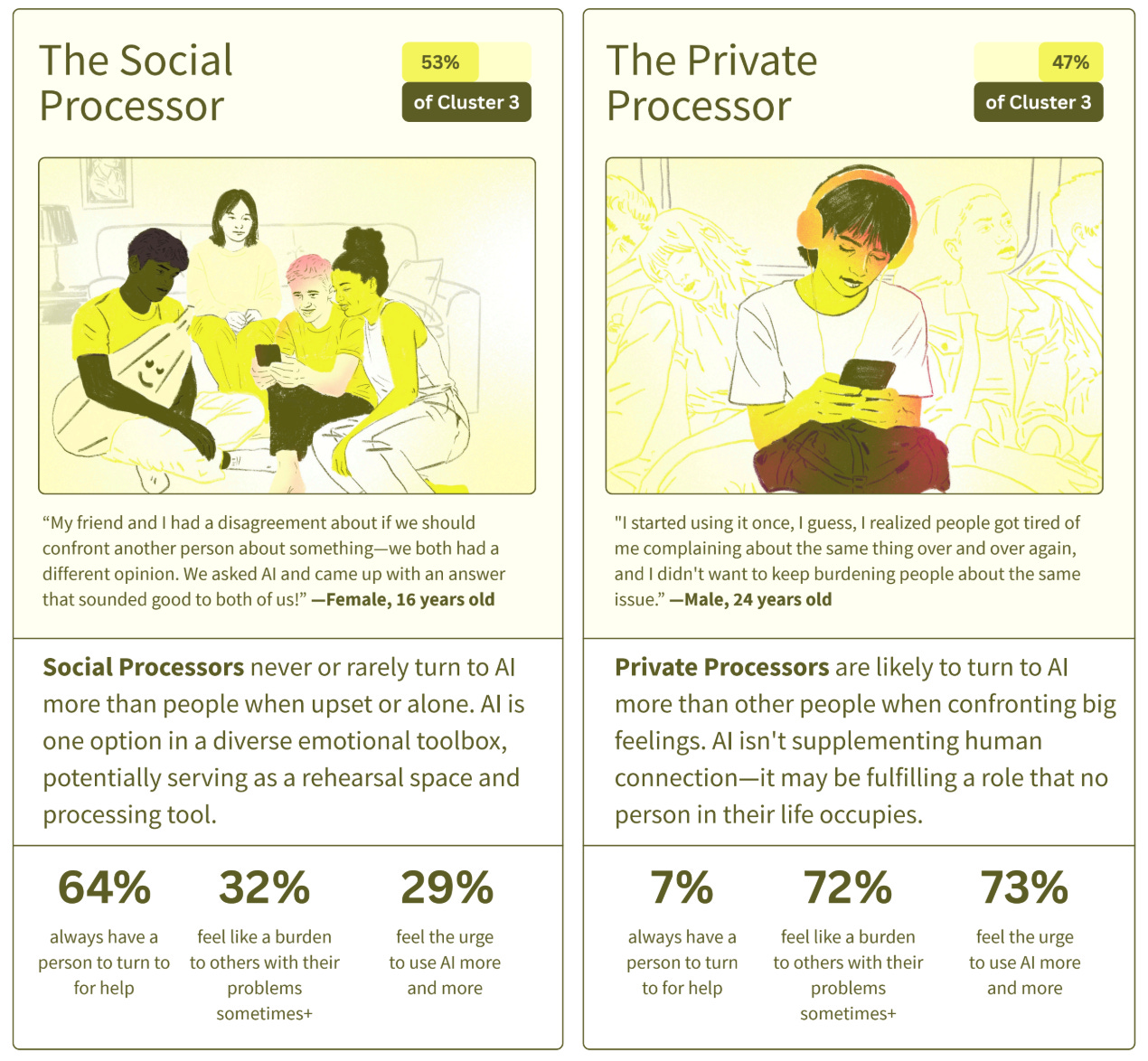
A new report by The Rithm Project asks what role AI is playing in young people’s social and emotional lives. Based on a YouGov survey of 2,383 young Americans aged 13-24, they identify four clusters: those who rarely or never use AI; those who use it mainly for information and tasks; those who use it for personal and relational support; and those who talk to AI characters.
One of the most interesting splits is in the third cluster. “Social Processors” use AI for advice on social situations. “Private Processors”, by contrast, appear to use AI more as a substitute for human support. This second group looks more vulnerable: they are much more likely to report turning to AI before people when upset, to feel like a burden, and to report an escalating urge to use AI more and more.
The concern, though, shouldn’t be limited to young people intentionally seeking emotional support from AI. A new paper by Yaoxi Shiet et al. argues that people can “stumble into” AI emotional dependence through routine chatbot use. In a month-long study, they found that daily five-minute personal conversations with ChatGPT decreased participants’ preference for seeking support from humans and increased their preference for seeking support from AI.
What else we’re reading
Is the iPhone Birth Control? Causal Evidence from AT&T’s 2007–2011 Carrier Monopoly - Myers and Hooper
Why Are Birthrates Down? Two New Studies Point to Phones. - New York Times
2026 Chatbot Legislation Tracker - Future of Privacy Forum
Limbic Capitalism Has Been Driving Addiction for Hundreds of Years - After Babel
Young People Don’t Want a Social Media Ban. We Want Better Social Media - Young People’s Alliance
Could the problem with boys be money? - Jonathan Wroble
We were promised sex robots - Business Insider
Events & Funding Opportunities
National Conference on Gambling Addiction & Responsible Gambling | Nashville, TN | July 22-24, 2026 | Call for presentations closed.
What did we miss this week? Do you have an upcoming conference or study we could feature in the next edition? Are you a state legislator thinking about how to design taxes on sports gambling? Let us know at bmonline@substack.com, or shoot me a message here.
If you haven’t already, please subscribe to stay up to date on Boys & Men Online.
And share!