

CTRL Panel
The American Enterprise Institute hosted a panel, Male Vice in an Internet Age, featuring our president Richard Reeves in conversation with Charles Fain Lehman and Daniel Cox (watch here). Their most interesting disagreement was about the role of policy and culture. Lehman’s view—which you might call “policy-first”—was channelled by Ross Douthat in a NYT piece that ran the next day:
In any society, politics is an arena for debates about the good life. The way the government taxes and spends and bans and regulates has a powerful effect on the behavior of its citizens, and what the law allows or forbids has some effect — not decisive, but inevitably influential — on what ordinary people think and do.
Richard Reeves was more wary about the role of the state versus the importance of agency and culture:
if we can kind of get to a place where we’re seeing heavy-handed law at least as the last resort rather than the first, that will lead to a better culture… I worry that if we end up reaching too quickly for prohibit prohibition, that will undermine the very character traits that we need to be able to live without it. (53:50)
Still, the tension between policy and culture shadows a wide area of agreement. Lehman, I suspect, agrees with Reeves that “the role of regulation is to add friction, [to] make it harder for [use] to become problematic use.”
The Feed
Does proximity to vice mean support for restrictions?
Eitan Hersh and Lucia Morissa-Corsetti put out a working paper (with accompanying Substack) on the relationship between exposure to vices and support for restrictions.
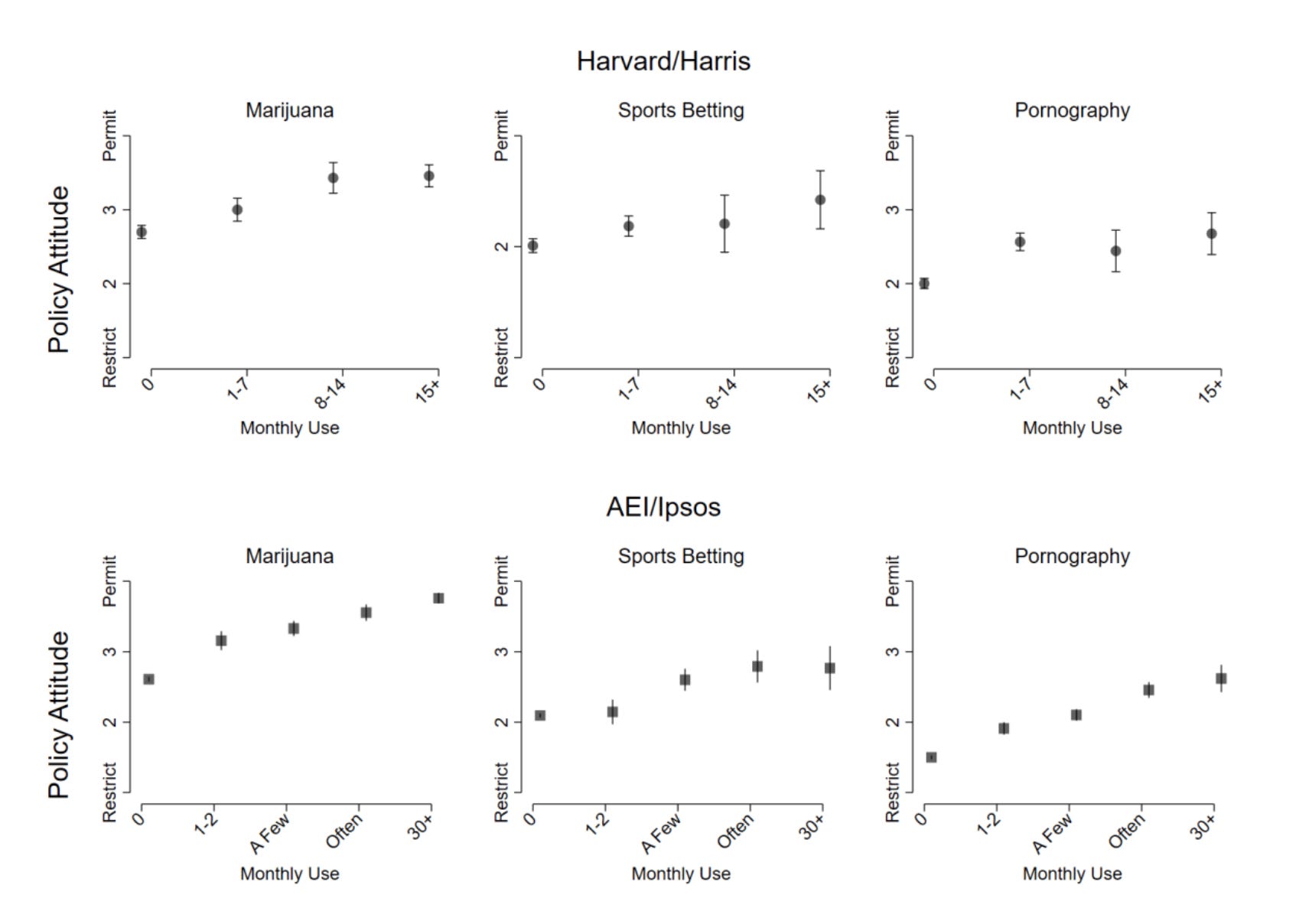
Across the board, they find that more frequent use is associated with more permissive attitudes towards regulation—even after controlling for demographic variables. The study also examines the attitudes of those who have a parent, child, partner, etc. who is a heavy user.
Of course, that doesn’t necessarily mean that becoming a frequent user causes more lenient attitudes. We asked Eitan to speculate on the mechanism at play.
From our DMs:
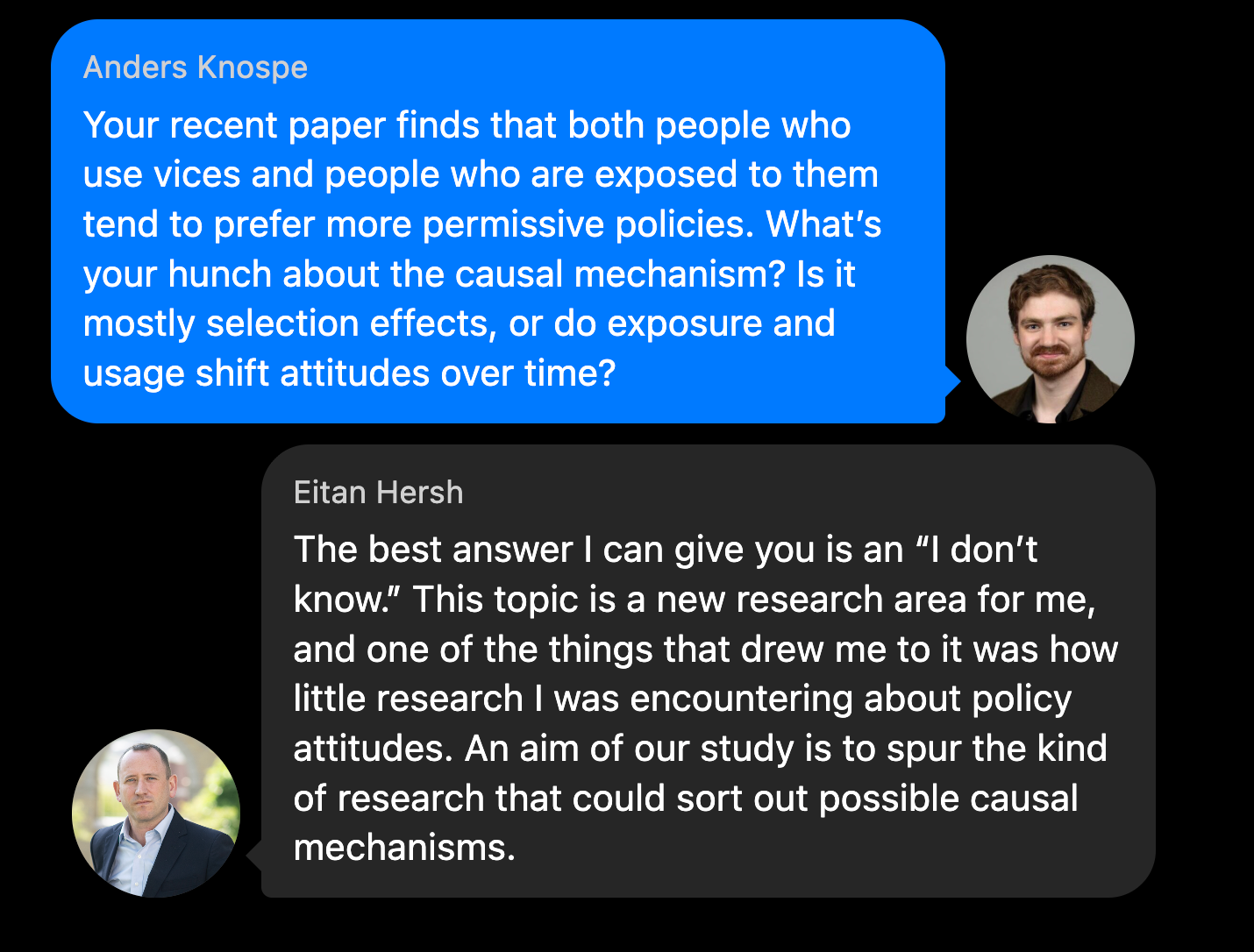
This is one of our favorite replies so far—Eitan is entirely right: more research is needed.
Public opinion and technical guidance on age assurance tech
Age verification is spreading rapidly: most recently, Discord announced that it will required an ID or face scan for access beginning in March. A Common Sense Media report finds mixed feelings about the policy. A wide majority favor requiring age verification for pornographic websites (84%) and gambling services (80%). But around the same share say they are very or somewhat concerned about children finding ways around age verification (80%) and about their children’s age data being sold or shared without their consent (86%).
Getting to the nuts and bolts, the Knight-Georgetown Institute released a report on what age assurance architectures look like in practice. A central insight of the report is that there’s no singular use case for age assurance. Some approaches are better for safer default settings (e.g., restricting personalized feeds), while others are better suited for full blocking (e.g., pornographic content). Adults want verification, and they want efficacy and privacy. But it’s much less clear where they would land on the concrete tradeoffs across different architectures.
Tristan Harris interviews Zak Stein on how technologies like AI companions can hijack our attachment system. One of my takeaways is that hijacking mechanisms (whether targeted at attachment or attention) can go both ways. If we have a grasp of the design features by which AI companions capture our need for attachment, we can design technology with those mechanisms in mind:
If it feels like you can have a more engaging conversation with this machine than with your teacher, either the machine is way too fancy or your teacher’s not trained well, but it should be the case that the machine should make it [so that you say], “Wow, I want to talk about that with my teacher.” So don’t do the deep anthropomorphization.
What else we’re reading
So we’re betting on everything now? - Good Work
Super Bet Sunday - Bill Maher
Who Calls 1-800-GAMBLER? Around Big Sports Events, It’s Often Young Men. - NYT
The Football YouTubers Who Are Therapists for Troubled Fans - NYMag
Deepfake Pornography is Resilient to Regulatory and Platform Shocks - Cuevas et al.
TikTok’s infinite scroll is too addictive, say EU regulators - The Verge
Gambling Addiction Research to See Federal Funding for First Time - Barron’s
Instagram Chief Says Social Media Is Not ‘Clinically Addictive’ in Landmark Trial - NYT
Events & Funding Opportunities
*New* Movember Request for Proposal - Esports and Gaming Mental Health Awareness Training | Closes March 6th, 2026.
International Conference on Gambling & Risk Taking | Las Vegas, NV | May 26-28, 2026.
National Conference on Gambling Addiction & Responsible Gambling | Nashville, TN | July 22-24, 2026 | Call for presentations closed.
What did we miss this week? Do you have an upcoming conference or study we could feature in the next edition? What role do you think culture and policy should play in managing vice? Let us know at bmonline@substack.com, or shoot me a message here.
If you haven’t already, please subscribe to stay up to date on Boys & Men Online.
And share!