

CTRL Panel
This week’s digest is all about… video games!
Gaming is easy to talk about badly. It can have real downsides for boys and young men if it slips into compulsive behavior or crowds out offline life. But it can also offer tremendous benefits. This week we walk through some research and resources on video games, and connect the findings to our broader work.
The Feed
Walking through different ways video games might affect mental health
Gaming is not one thing, nor are its effects. This paper walks through 13 plausible mechanisms through which gaming could influence mental health, and shows how to translate intuitions into causal models that can be rigorously tested. The authors suggest that researchers should study specific features and causal pathways, rather than treat “gaming” as a single variable. So, for example, instead of studying whether gaming is good or bad for mental health, researchers can explore whether late-night, high-intensity gaming worsens mood by disrupting sleep, or whether social gaming improves well-being relative to solo gaming.
The same shift would benefit research on pornography. Rather than testing associations between porn use and mental health, researchers ought to rigorously test specific causal mechanisms.
Researchers at Oxford released Open Play, a new longitudinal dataset which includes psychological measures (mental health, well-being, etc.) and digital trace data across multiple gaming platforms (Steam, Xbox, Nintendo Switch, iOS, and Android), time diaries, and a host of other measures.
I downloaded the dataset, threw it into Claude Code, and spent half an hour playing around. Here’s one finding: Overwatch 2 players have the lowest average well-being of any major game in the dataset. (If you’ve played Overwatch, you will not be surprised.)
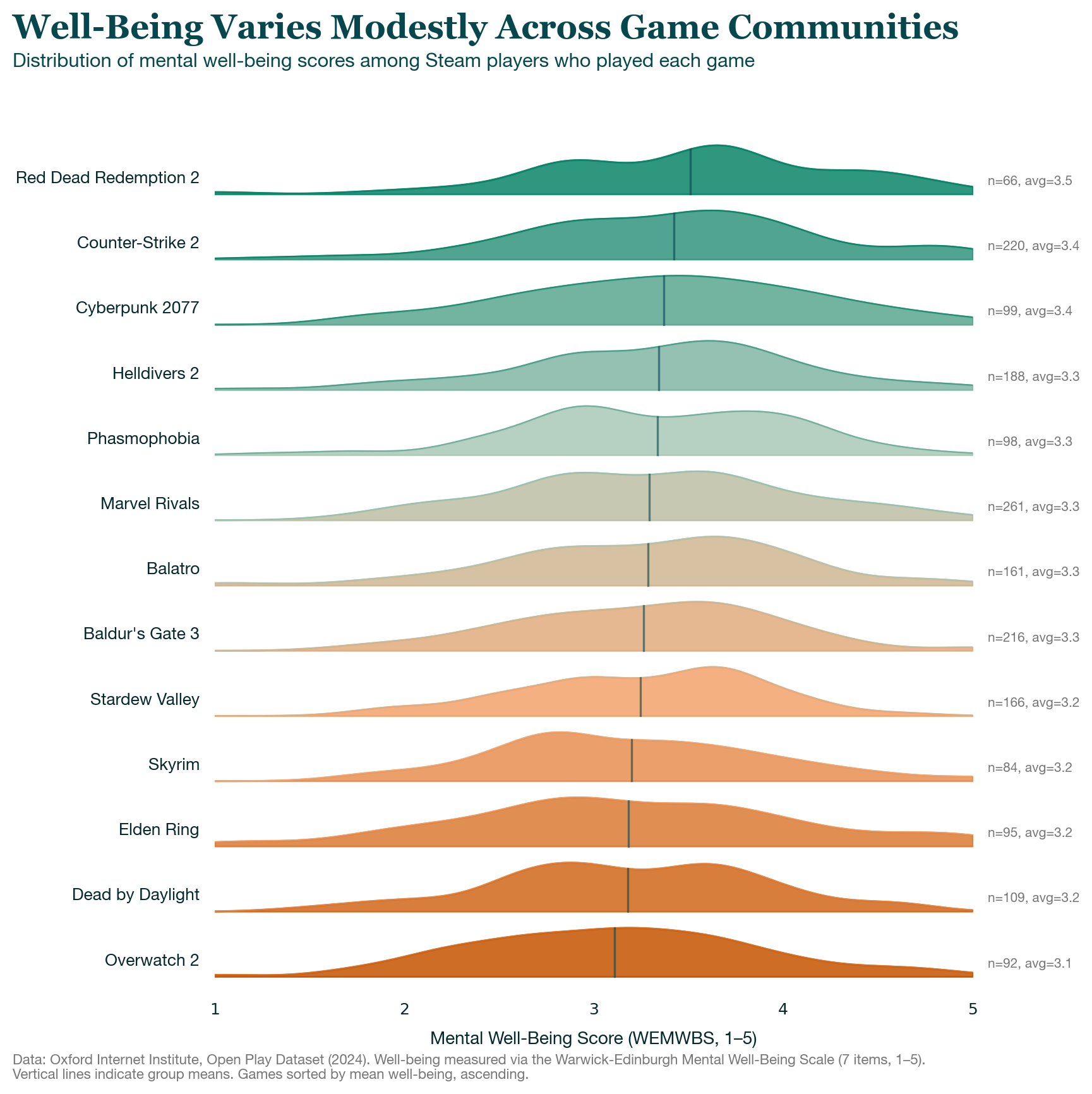
Some other questions you can use the Open Play dataset to explore:
Do people stay up later gaming after a stressful day?
Is the relationship between gaming and well-being different for weekend versus weekday gamers?
How does becoming a caregiver reshape gaming patterns?
How do reaction times relate to time spent gaming?
Differences between problematic gaming and problematic gambling
An fMRI meta-analysis comparing Internet Gaming Disorder (IGD) and Gambling Disorder (GD) found no significant shared activation cluster in the brain, suggesting different underlying cognitive mechanisms. While GD was associated with greater activity in regions linked to reward valuation, IGD was associated with greater activity in regions associated with attention, monitoring, and emotional-cognitive regulation. Treating these disorders as neurologically similar may be incorrect.
Did better video games pull young men out of the workforce?
Between 2000 and 2015, working hours for men aged 21–30 fell about 12 percent—significantly more than for older men, women, or any other group. The economists who wrote this paper traced where those lost work hours went, and found that the majority went to video gaming and recreational computer use. The paper’s key insight is that gaming functions as a “leisure luxury” for young men—meaning the more free time they have, the disproportionately more they devote to it. As gaming technology improved through the 2000s, they argue, it raised the value of free time relative to paid work. The paper doesn’t argue gaming caused young men to stop working, but that it got good enough to shift the calculation, especially for those living with parents for whom the financial cost of working less was cushioned.
→ Of note: Over at AIBM.org, Thomas O’Rourke’s analysis of American Time Use Survey data finds that both male and female NEETs spend roughly 5 hours per day watching TV and engaging in “other” leisure activities, but male NEETs spend roughly 2 additional hours per day playing video games.
What else we’re reading
Gambling, Drugs, and Porn: What I Learned at a Conference on Vice Policy - Isaac Rose-Berman
How early porn exposure is impacting young men - USA Today
Siena/SBU Survey: Over half of men 18-49 have sportsbook accounts - Siena & St. Bonaventure University
Social Snacks: AI Companions and the Hunger for Connection - Data & Society
CFTC sues Arizona, Connecticut, Illinois over prediction market regulation - CNBC
Do 3pm to 3am screentime bans work? - Center for Teen Flourishing
Teens are using AI—but not how we think - Brookings: TechTank podcast
Events & Funding Opportunities
*New* Webinar: Financial Health, Gambling, and Prevention: A Cross-Industry Conversation | April 16th, 2026.
Online Gambling and The Public Health Movement: An International Symposium | Boston, MA | April 24th, 2026.
*New* Young Futures Block Party | Austin, TX | May 13-14, 2026.
*New* Young Futures Express Yourself Grant | Supporting bold solutions that help girls, boys and trans- and gender-expansive young people build confidence, belonging, and agency in a digitally shaped world. | Proposals due May 19th, 2026, 8 PM ET.
International Conference on Gambling & Risk Taking | Las Vegas, NV | May 26-28, 2026.
National Conference on Gambling Addiction & Responsible Gambling | Nashville, TN | July 22-24, 2026 | Call for presentations closed.
What did we miss this week? Do you have an upcoming conference or study we could feature in the next edition? How do you think we should design video games for well-being? Let us know at bmonline@substack.com, or shoot me a message here.
If you haven’t already, please subscribe to stay up to date on Boys & Men Online.
And share!
Good article Anders. If you ever want to chat about games with an OG like myself, happy to do so. I've been designing board games for 30 years, and have lived with an addiction to one solo computer game (oh the bargaining). My $.02: the social benefits for in-person gaming are much higher vs. online gaming, but online is still positive if handled sensibly.