

CTRL Panel
Last week, I came across a paper that has quickly become one of my favorites. It draws on several kinds of evidence to trace how technology has changed young adulthood over the last two decades.
Nathan Hudson and Hernán Moscoso Boedo argue that digital technology may have reduced young men’s labor-participation, not primarily by displacing work, but by contributing to a decline in marriage. They make the case in three steps:
First, they find that roughly one-third of the male workforce participation decline—and most of the corresponding female increase—can be chalked up to the fact that unmarried men are less connected to the work-force, and there are now more unmarried men.
Second, they use time diary data to show that single men shifted around 30 minutes a day towards solitary screen time between 2003-07 and 2015-19, and away from friends—but not directly away from work.
Third, cohorts whose formative years overlapped more with local 4G coverage also married at lower rates, suggesting that digital technology may affect men’s employment indirectly by displacing social connection and therefore partnership formation.
My takeaway: digital life is not simply changing how we spend our time. For some, it is shaping the structure of young adulthood and the relationships that tie them to the workforce.
We’ve just published a new brief on young men and crypto — who’s buying, what they’re risking, and why digital assets are especially appealing to young men. The publication was co-published by David along with Diego Nunez, who just wrapped up his summer internship with us.
The Feed
More evidence for financial impacts of online gambling
A new paper uses household panel data from the Survey of Income and Program Participation (SIPP) to study the staggered expansion of online gambling’s effects on financial well-being, finding that legalization increases average household credit card debt by about 11.9% in the relevant states — roughly $470 additional credit card debt per year. The effects were strongest among young men aged 21-45 (+13.4%) and black household heads (+29.7%).
This increase in credit card debt complements earlier evidence from New York Fed researchers Goss and Mangrum, who found that sports-betting legalization leads to rising credit distress: overall serious delinquency increased by about 0.3 percentage points, with particularly large effects among borrowers under 40, whose credit-card delinquency rose by about 1 percentage point.
Porn, gambling, and video games among demoralized men
The Institute Family Studies released part II of their report America’s Demoralized Men. The second part—based on a 2,000-person survey of men aged 18-29—covers social connection and alienation, with a particular focus on technology use. The report finds strong correlations between various forms of daily use and feelings of demoralization:
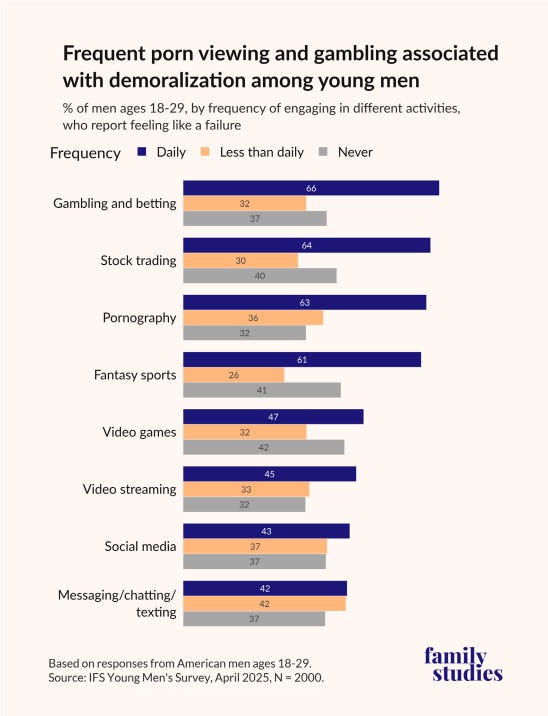
They also find that about 2 in 5 regular gamblers report experiencing moderate to severe emotional distress from online gambling.
Gen Z Wants to Do Good: How Helping Others Supports Meaning and Wellbeing
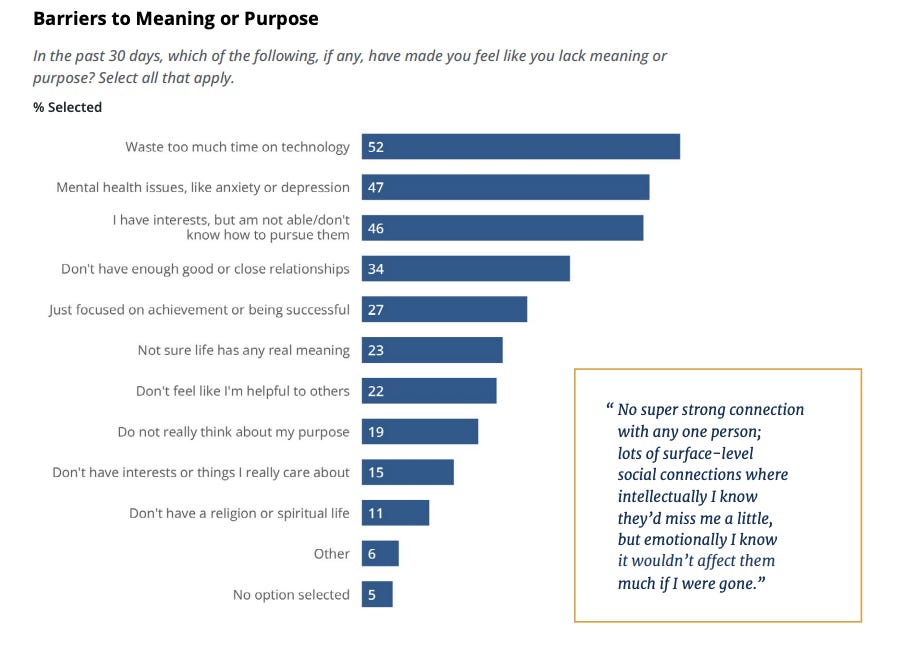
A new Gallup survey finds that many young Americans see excessive and unproductive technology use (52%), mental health issues (47%) and a lack of close relationships (34%) as barriers to finding purpose. The findings are especially concerning for young men: 42% of adult Gen Z men do not feel needed by others, and 35% do not believe they make a positive difference in people’s lives.
Those who feel they positively affect others are three to four times more likely to experience meaning or purpose, suggesting that helping young men build close relationships and feel needed through work, service and community could support their wellbeing.
Against the manosphere “rabbit hole”
Harmony Labs and LinkUp Lab released a new report on men’s media consumption and its relation to their well-being. The wide-ranging report includes analysis of what kind of stories draw men to streaming content, a segmentation of men into five audiences with different values and media diets, and a deep dive into the “manosphere” rabbit hole — along with guidance for content creators trying to reach men. We were most drawn to their findings on the manosphere rabbit hole:
Direct consumption of extreme manosphere channels is vanishingly rare. Their eight anchor channels (e.g. Fresh & Fit, Whatever) found each reaches about 0.01-0.03% of men in the panel on any given day — versus 1.16% for streamers like penguinz0.
There’s little evidence for a monoculture, or an escalating pipeline. Men who do engage with manosphere channels tend to also engage with ordinary mainstream outlets like CNN, Fox News, SNL, and ESPN. The idea that men’s attention needs to be diverted elsewhere is misguided because it’s already distributed.
What else we’re reading
Brain activity inhibition during Short Video Viewing: neurochemical insights - Hong et al.
Court orders Instagram and Facebook’s Meta to pay $567M to address kids’ mental health online - NPR
The Grift Economy - Equimundo
Status defines friendship for too many Americans — Christine Emba
Events & Funding Opportunities
NCPG welcomes grant applications from any U.S. based nonprofit engaging in problem gambling prevention programming | Deadline: August 19, 2026
Family Online Safety Institute Conference | Washington, D.C. | November 19, 2026
What did we miss this week? Do you have an upcoming conference or study we could feature in the next edition? Do you have an intuition about how pathways into problematic gambling may have changed over the past decade? Let us know at bmonline@substack.com, or shoot me a message here.
If you haven’t already, please subscribe to stay up to date on Boys & Men Online.
And share!