

CTRL Panel
I’m filling in for Anders Knospe this week. He’ll be back for the next digest.
Can a face scan keep teenagers off betting apps?
A bipartisan federal proposal announced last week would require sportsbooks and prediction markets to use facial recognition or facial age estimation when a user logs in or places a wager. It targets a real loophole — reporting from NPR describes how teens can bypass legal age restrictions to gamble by using shared devices or an adult’s phone.
Noting the workaround, Rep. Josh Gottheimer observes, “We wouldn’t accept that at a casino in Las Vegas. We shouldn’t accept it on the phone in our kid’s back pocket.” The move follows a similar effort by New York’s Governor Hochul in March.
But it leaves a harder question unresolved: should 18-year-olds be allowed to gamble on their phones?
The proposed bill could help prevent teens from placing bets on the phones of adults. It could also normalize 18 as the federal age to provide unlimited access to gambling. But most Americans think online gambling should be restricted to 21+. A recent poll of 1,514 registered voters by Change Research found that 76% of respondents think online gambling should be restricted to 21 and above. Majorities also preferred a 21-plus threshold for pornography websites and cryptocurrency trading apps, but not for AI companions, gaming platforms, or social media.
The Feed
New data on sports betting prevalence
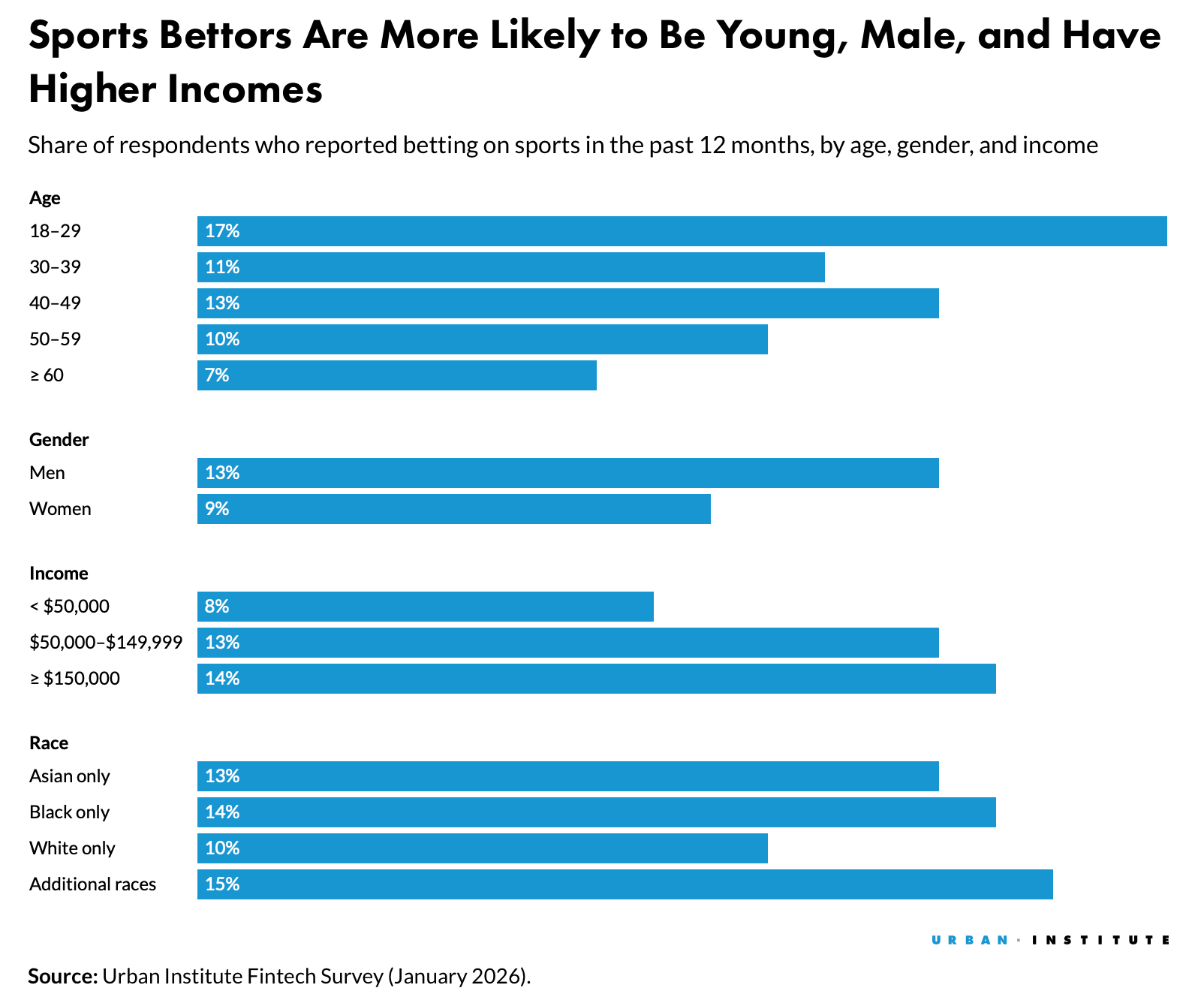
New research by the Urban Institute examines how and why Americans bet on sports. Among the findings from a nationally representative survey (n=3,194):
17% of Americans age 18-29 report betting on sports in the past 12 months. Of adults overall, men (13%) are more likely to bet on sports versus women (9%)
Most bettors bet infrequently: about half have only bet “once or twice” in the past year, and just 4% report betting daily.
Few bettors report missing bill payment because of betting (3%), but more (12%) report having saved less money than they would have otherwise because of sports betting.
The Urban Institute also released similar research briefs on cryptocurrency and Gen Z’s financial attitudes.
Settlement manipulation in prediction markets
Using Polymarket’s trading records and Binance crypto data, the authors of this preprint find evidence of traders manipulating Bitcoi
n prices during the final seconds of five-minute “up/down” contracts. They identify roughly 1,600 likely manipulations and 821 accounts that earned $8.2 million from them; 93% of the resulting losses fell on retail traders. After sports, wagering on the price of crypto is the most common activity by volume on Kalshi.
Safer defaults reduce exposure to harmful content
Participants aged 13–15, 16–17, and adults used a simulated social platform with varying defaults for messaging, location sharing, and network expansion. Users frequently maintained safer, more restrictive defaults, suggesting that reducing harm need not depend entirely on self-control. With vibe-coding bringing down the cost of simulated platforms, we’d like to see similar studies testing default guardrails for gambling apps.
Prices, Probabilities, and Parlays
A prediction market contract trading at 30 cents is normally understood to imply roughly a 30% chance of paying out one dollar. This preprint paper finds that Kalshi’s 30-cent sports parlays won only about 24% of the time. Put simply, buyers paid 30 cents for something returning an average of approximately 24 cents before fees. The discrepancy grew as additional legs were added.
What else we’re reading
Betting on Better Evidence — Arnold Ventures announces a $2.6 million research portfolio on gambling exposure, financial harm, industry tactics, and policy effectiveness.
From isolated openings to streaks: a sequential observational study of loot box openings in livestreamed gaming — This paper examining loot-box openings in livestreams finds that the vast majority (93%) of loot boxes are opened in streaks rather than as isolated events.
European Commission preliminarily finds the addictive design of Instagram and Facebook in breach of the Digital Services Act — The Commission found that Meta failed to address addictive design, including infinite scroll, autoplay, push notifications, and highly personalized recommender systems.
A year of age assurance under the UK Online Safety Act — Early evidence from the UK telecom regulator that age verification creates friction but remains incomplete and vulnerable to circumvention.
Jonathan Haidt Is Wrong About Age-Gating the Internet — Kelsey Piper favors restrictions on advertising and engagement design, chronological feeds, and device-level controls. She suggests devices for adolescents that “as a hardware restriction, didn’t access vice sites (like porn or gambling).”
How young people are coping with the attention economy — Young Futures introduces a documentary series centered on young people’s own accounts of attention, connection, and digital well-being.
Why Is Everything Gambling Now? — A holistic framing of gambling mechanics spreading across finance, entertainment, and digital platforms.
Warren Buffett and Kalshi’s CEO disagree on gambling versus investing — "Since humans love to gamble so much, there's more money in cultivating gamblers than investors."
How this World Cup is being used to turn a new generation of teens into gambling addicts — Researcher Darragh McGee argues that smartphones, in-play wagering, targeted advertising, inducements, and casino cross-selling have transformed sports betting from an occasional act into continuous engagement.
The Black Markets Fallacy — Charles Fain Lehman argues that the existence of black markets is not a convincing case against banning vice.
Events & Funding Opportunities
National Conference on Gambling Addiction & Responsible Gambling | Nashville, TN | July 22-24, 2026 | Call for presentations closed.
NCPG welcomes grant applications from any U.S. based nonprofit engaging in problem gambling prevention programming | Deadline: August 19, 2026
Family Online Safety Institute Conference | Washington, D.C. | November 19, 2026
What did we miss this week? Do you have an upcoming conference or study we could feature in the next edition? How do you think we should handle young people’s technology use? Let us know at bmonline@substack.com, or shoot me a message here.
If you haven’t already, please subscribe to stay up to date on Boys & Men Online.
And share!