

This post was written by Ben Samuels. In addition to his work on online gambling, he writes about policy and politics every two weeks.
Since the Supreme Court allowed states to legalize sports gambling in 2018, it’s been an all-out land grab for FanDuel, DraftKings, and other gambling platforms: to push for state-by-state legalization, to acquire customers, and to make gambling an integral part of watching sports.
By almost every measure, they’ve succeeded. State-licensed sports gambling is legal in 39 states; it’s legal online in 27 states.1 But as the American Institute for Boys and Men has written about extensively,2 this has had profound social consequences:
When states legalize online betting, bankruptcy rates rise as much as 30%.3 One study found that for every dollar bet on sports, investment contributions fall by 99¢.4
When states legalize online betting, alcohol consumption goes up, calls to gambling helplines go up, child maltreatment goes up, and food insecurity goes up. Problem gamblers are much likelier to have suicidal tendencies.
Projected state tax revenues from online gambling have been far lower than what was promised. When you factor in societal costs—higher bankruptcies, higher rates of substance abuse, more violent tendencies—states may be losing money.
When you look at young men, what we’re seeing is even more concerning. So-called “prediction markets” like Kalshi, which are largely unregulated and available to any American 18 or older, are really just sports gambling platforms in disguise. They’re exacerbating this problem.5
Most alarmingly of all, gambling apps, prediction markets, pseudo-gambling apps, freemium games, and more are all targeting boys under 21. These companies are creating a funnel that has young men habitually—and often problematically—gambling well before they should legally even be allowed to open an account.
Boys under 21 can’t legally gamble, but they’re doing it anyway
Common Sense Media put out a terrific report on how boys under 18 are gambling. Gambling is pervasive, even among boys as young as 11.6
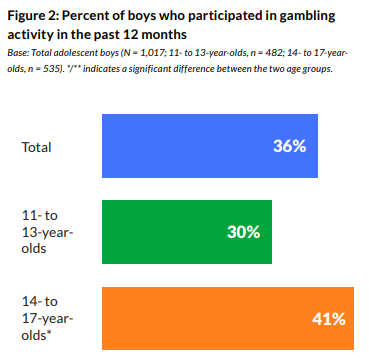
Source: Common Sense Media
This isn’t inherently bad. I think most parents would be fine with their teenage boys playing a poker game at home with friends, or putting a few dollars into a March Madness pool. For lots of boys under 21, it really is just that.
But home poker games don’t blow up your phones with notifications, nor do they offer ACH withdrawal, nor are they available 24 hours per day.
Minors can access online casinos through offshore and unlicensed platforms, crypto casinos, or accounts belonging to parents and older siblings, all of which are common and easy workarounds. Consequently, even if it’s nominally illegal, young men—who are especially susceptible to gambling addiction—are getting themselves into serious trouble.7
There’s a lot of harrowing, well-researched reporting on boys getting themselves into serious debt before they turn 18. And of course, countless other stories are never told.
“Teen gambling is turbocharged thanks to sports-betting and prediction markets. Parents often have no idea.” (MarketWatch)
“Gamification and memes lure young people to sports wagering apps and prediction markets” (Associated Press)
“‘Public health crisis’: Experts weigh the stakes of youth gambling in America” (ABC News)
“Prediction markets have made betting easier than ever—and young men are paying the price” (Fortune)
“Young man reveals how online gambling put him thousands in debt before age of 18” (ABC 7 NY)
These trends are likely to accelerate as prediction markets—which are available in every state, are less regulated, and have an age limit of 18 rather than 21—become more prevalent.
While we know that prediction markets can feed gambling addictions, we don’t know how many of their users are under 21. That’s because they’re not required to disclose who’s gambling on their platforms.
Despite requests from members of Congress, these companies have opted not to share that information.
Gambling ads reach—and target—boys under 21
Obviously, boys who are watching television are going to see the (ubiquitous) ads for FanDuel, DraftKings, Kalshi, and other platforms that are spending billions per year on advertising.8
That may not be ideal, but it’s hardly unique. Beer companies get to advertise on television, and that’s not meant to reach minors.
What’s more alarming is that boys are more likely to encounter gambling ads on platforms capable of targeting them directly (namely, YouTube and social media):
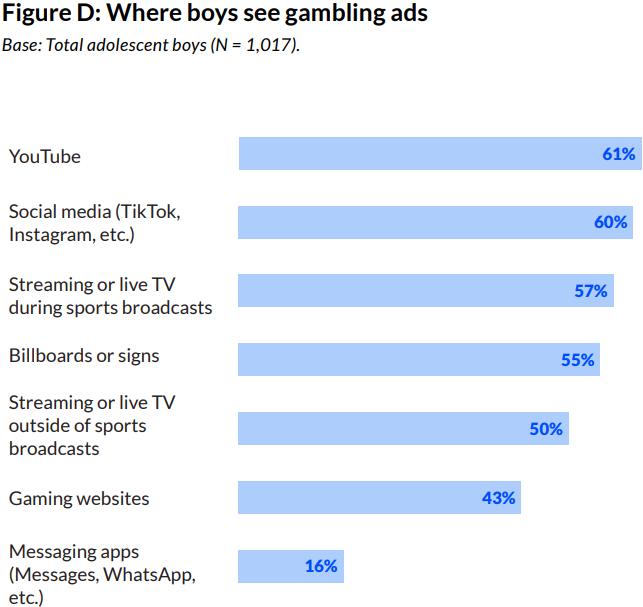
Source: Common Sense Media
The content on social media can be relentless, and it seldom includes disclaimers about gambling addiction, which violates the gambling industry’s own guidelines.
FanDuel, DraftKings, and others have public positions about their commitment to promoting responsible gambling and preventing minors from gambling. In practice, they don’t operate that way.9
Their public comments on the topic are fairly explicit. Here are a few examples from investor presentations and earnings calls:
Back in early 2021, FanDuel put together slides on “Attracting and Engaging Gen Z” and “Building a Product for Gen Z.” Keep in mind that at the time, the vast majority of Gen Z wasn’t of legal gambling age: approximately 20% of Gen Z was 21+, and approximately 40% was 18+.10
FanDuel and DraftKings are actively thinking about how to make sure that young adults are in their pipeline. This question came up in a DraftKings earnings call earlier this year,11 and FanDuel last year announced the launch of FanDuel Predicts explicitly as “a new prediction market product which will include sports in states without access to regulated sports betting.” Prediction markets are 18+, not 21+.
Super Group, a gambling company that trades on the NYSE, spoke about “a growing population of customers turning 18 and 21 every year” abroad as a demographic opportunity for the company.
Moreover, all of these companies are hiring brand ambassadors who are popular with people under 21. Take Pat McAfee, who just signed a sponsorship deal with DraftKings to replace his FanDuel sponsorship deal, which was worth up to $30 million per year. He has a large TikTok following, and his content is immensely popular among people under 18and among people ages 18-21, who are exposed to all of his gambling content.12
Polymarket may be the most shameless, hiring brand ambassadors in fraternities and paying them to recruit new customers. College campuses have been particularly lucrative for prediction markets.
Believe it or not, these aren’t even the worst actors. Plenty of illegal casinos operate without proper disclosure, operate without licenses, and target minors.13 Ads for these casinos are nominally prohibited on Instagram, YouTube, and Twitch, but they proliferate anyway, and teenagers have found themselves deep in debt well before they’re legally allowed to gamble.
What can be done?
As anyone who’s ever been a teenager on the internet can attest, it’s very easy to break the rules. And while some of that creativity is admirable—a fake moustache to get around AI age verification tools, for instance—minors can get themselves into serious trouble before they even turn 18, much less 21. Gambling companies have little interest in keeping them from seeing their ads and sponsored content.
What’s more, these companies use aggressive, predatory methods that aren’t legal elsewhere in the world to reach new customers. U.S. regulation hasn’t caught up.
Four policies that are obvious and urgent:
Regulate advertising for prediction markets. Right now, they’re basically unregulated. That’s a regulatory oversight at best, and they should be subject to the sorts of rules that other online casinos face.
Require more extensive disclosures. For prediction markets, how many 18-to-20-year-olds are using these platforms? How many minors are trying to create accounts? How much of their content on social media is being seen by minors?14
Limit how much young gamblers can wager per month. Flutter, an Ireland-based gambling company, limits gamblers under 25 to £500 per month. That should be enshrined in American regulation.
Crack down on illegal gambling. Crypto casinos and other unlicensed offshore casinos are operating in the U.S. without consequence. State and federal regulators must do better to enforce the laws already on the books.
This is a perpetual game of regulatory cat-and-mouse. Despite what they’ll tell you, gambling platforms are reliant on high-frequency problem gamblers, who drive much of the platforms’ profits. They know that young men in particular are especially vulnerable—and, therefore, especially lucrative.
Public discourse is starting to shift on this issue, and Americans are likelier to say that legal sports gambling is bad for society than they were a few years ago.
It’s not the primary societal concern, but athletes are speaking up about the harassment they’re dealing with. At a press conference during the British Open, professional golfer Matt Fitzpatrick articulated the abuse athletes face from gamblers. It’s why the NCAA has called for an end to prop bets on college athletes, who receive all kinds of threats.
I have also written about this extensively, which is why AIBM and I are partnering on this topic.
That’s within just four years of legalization.
What other studies find isn’t quite so dramatic, but what’s clear across all of the research is that this isn’t just entertainment money. It’s replacing savings for retirement.
As a primer on gambling apps, prediction markets, etc.:
Conventional sportsbooks generally require customers to be 21.
Prediction markets generally require customers to be 18.
Illegal casinos and other pseudo-gambling products reach children much younger than that.
All of them have rules that can be circumvented.
Data from the NCAA tells us that the rates of gambling increase after people turn 18. 58% of 18- to 22-year-olds—and 67% of students living on college campuses—have bet on sports alone. (Which means, presumably, that rates of gambling defined more broadly are even higher.)
Good data on what constitutes “serious trouble” is challenging to come by, but this chart tells an interesting story:
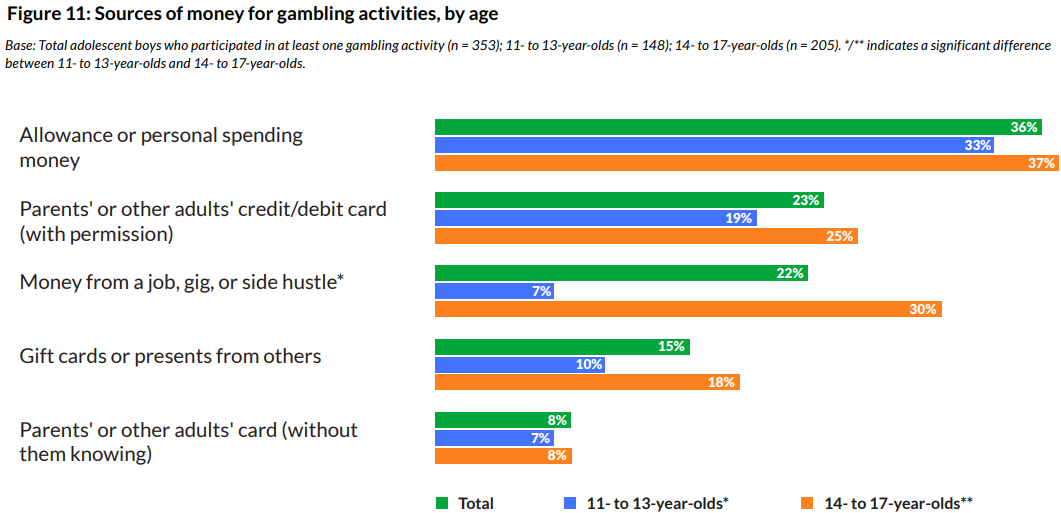
Source: Common Sense Media
There is more than one way that gambling can be problematic. But using your parents’ credit cards without their knowledge is unquestionably problematic behavior—even if it doesn’t constitute a formal gambling addiction.
According to SEC filings, in the year ending December 31, 2025:
DraftKings spent about $1.1 billion on advertising.
FanDuel spent about $1.3 billion on advertising.
The same data is not available for companies like Kalshi, which aren’t publicly traded and therefore don’t have the same disclosure requirements. It’s nonetheless clear that these companies are spending fortunes on advertising.
This remains one of my favorite SNL sketches:
This is some pretty back-of-the-envelope math, assisted by ChatGPT. It still roughly checks out if you assume an even distribution during Gen Z’s birth years of 1997-2012.
Specifically, the question from an analyst (emphasis added):
Just on customer growth and MUP [monthly unique payer] growth, I realize it was up low single digits ex the lottery. Can you just talk about trends there? I think there’s a slide in your shareholder deck that says 30% of volume -- of Prediction Market volume in regulated states is coming from regulated markets. Is there something where younger customers that are like 18 to 20 just aren’t shifting over to DraftKings as they get older? Or can you just talk about the MUP trends?
It’s worth noting that the predatory behavior isn’t limited to minors. MLB star Bryce Harper sent a video to a FanDuel client as part of that gambler’s VIP treatment. (Bryce Harper, somewhat implausibly in my view, denies that he had any knowledge of what was going on.)
Sometimes, minors are gambling with real money. In other cases, they’re gambling for things like “skins,” which are limited-edition costumes for video game characters, some of which can go for thousands of dollars at auction.
The information available to advertisers on social media is so expansive that this data surely exists.

I found the article fun, but much of it had "news headline science smell". It seemed like thing were always reported as extremely as possible, from taking a $1->99¢ result sans-explanation, to (implicitly) mischaracterizing what share of prediction market inflow is from sports betting, to critiquing marketing to Gen Z when only 20% are legal to sell to (or, to say it otherwise, imagine a toy company marketing to them a few years later and being criticized for having "only 20% of Gen Z still buying these" — while these companies are scummy, this wasn't relevant).
Michael Crichton used to talk about "the Gell-Mann Amnesia effect", where, when every part of the news you can interpret has a certain type of issue, you ought to realize that all the parts you are ignorant of likely have the same issues. Here, every part I could understand overstated things or interpreted them as much more hostile than warranted. So I am left confused about how to interpret the parts that are new to me.