


Introduction from David: What helps a teenager spend less time on his phone when there is little else he wants to do?
We are partnering with our friends Mike Goldstein and Sean Geraghty of the Center for Teen Flourishing to publish a series of case studies about their work coaching boys to reduce their screentime and improve their grades. In this first case installment, Sean describes how he helped a 16-year-old, Gary, cut his screen time in half. I’ll share my reflections at the end.
Introduction from Sean: Gary’s story draws mostly on my work with one teenager and includes details from a second family. The change in phone use and the four activities that filled his week came from the same teenager.
When I met Gary he was spending about 50 hours a week on his phone, mostly scrolling on TikTok.
How was his life going? Meh. Not much going on.
School? Pretty mediocre, mostly Cs.
Friends? Didn’t see them much.
Was he depressed or anxious? I don’t even know. I’m so bored though.
Brothers? He got along well with them, but they were all grown up, out of the house.
How’s his relationship with Mom? Okay.
Dad? Not great. The relationship was a two out of 10, Gary said.
Dad agreed. “Gary and I both feel like we’re mad at each other all the time,” his dad said. Gary was their youngest. His three older brothers were “easy,” in Mom and Dad’s words. Their parenting had “worked.” Those guys were thriving.
Mom felt stuck in the middle of dad and Gary, and under enormous strain.
“It feels like we all fight all the time,” she said.
It wasn’t always like this. Gary had been, by all accounts, a remarkably pleasant and successful child. Both parents would return to that point again and again, almost in reverie for the old Gary. Remember when?
But a few months ago, Mom and Dad noticed that he’d fallen in with the wrong crowd. Those guys ate edibles before school, would steal an umbrella or candy from a CVS, were nice enough but had no aspirations. They worried: was this the new Gary?
They made a bold and unpopular parent move. They switched Gary’s school, against his will. He freaked out. They held firm.
His new school was a well-regarded magnet school, with more aspirational students.
Not surprisingly, this did not impress Gary one bit.
I asked Gary how the new school was going.
Terribly, he said. Classes are much harder. I goof off and get in trouble – there’s an assistant principal who emails my parents with whatever I do wrong.
I miss my friends. The kids here are too serious. I go with some guys to McDonald’s for lunch. Those guys are obsessed with their GPA. I’ll try to lighten things up, like maybe let’s cut our afternoon classes, just to get some energy going, some vibe. They laugh me off.
Has he joined anything?
He tried out for basketball, and made the JV team. He didn’t like it. He seemed embarrassed to be “Just JV” as a junior.
Dad had gotten a call from the coach. Gary goofs around, cheats on the sprints, has cut a few practices. Coach is not a fan. Dad knew Gary could play, a strong rebounder, no touch from outside, but the coach was threatening to cut him and Dad totally got it. “What the hell is Gary doing?” Dad asked me.
Things blew up a few days later. Gary refused to run the sprints and told the coach he was too tired, and that was the last of the coach’s patience. Coach crashed the f*** out, Gary told me, laughing about it. I thought the laughter was posturing a little. He couldn’t feel good about that.
I gently asked Gary about the TikTok surge. He told me he’d say something disrespectful to his parents and get grounded. The grounding forced him into his room; the room is where the phone was.
That was his initial story. I pushed him a bit – well what about when you’re not grounded? Well, he’s still on TikTok – last weekend he wasn’t grounded and the hours were still there.
I showed Gary this graphic. Many teens feel like they spend too much time on social media. I asked his reaction.
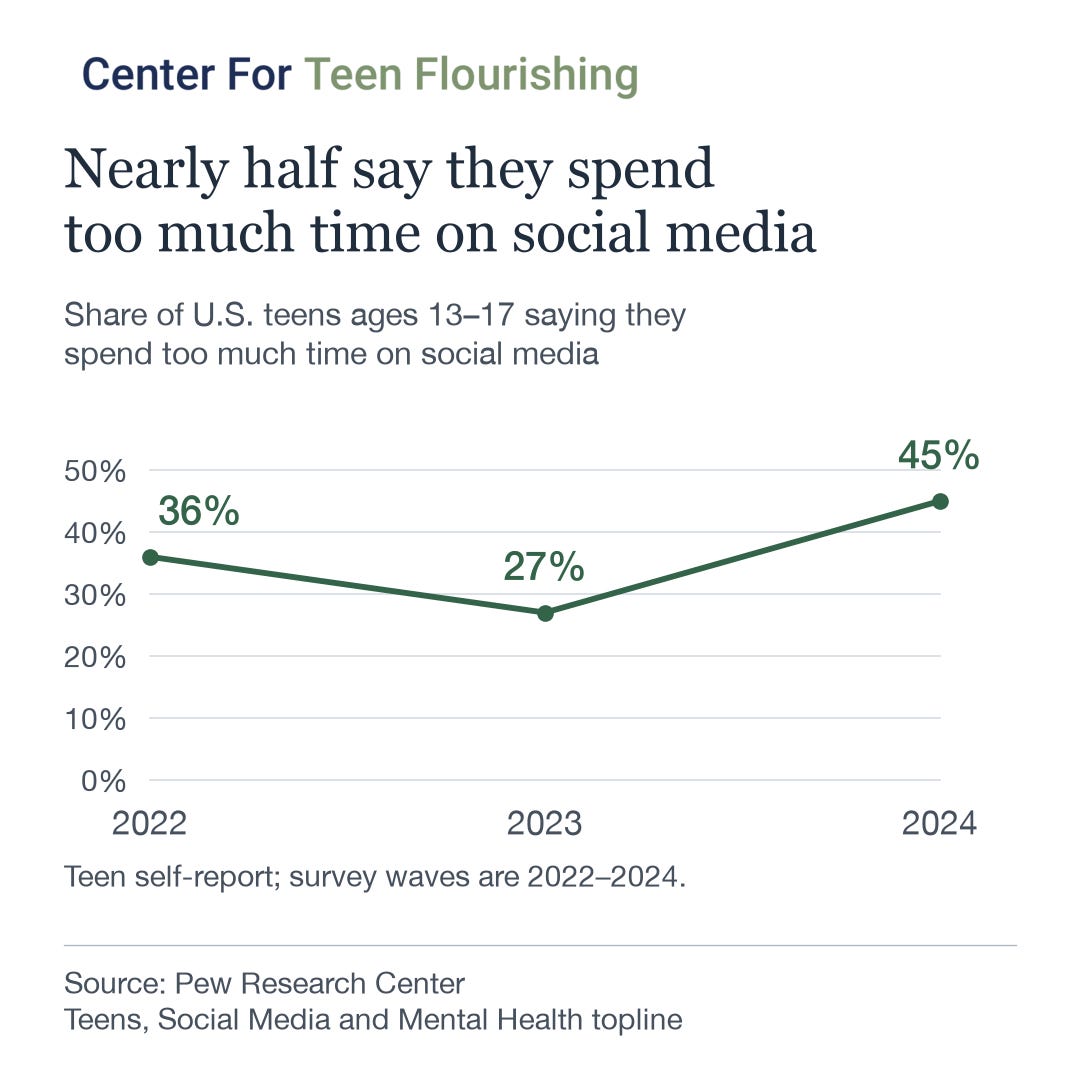
That’s me, he said. He was intrigued at how common of a problem it was. No guy actually says that out loud.
I asked if many of his old friends were on screens as much as him. More than me! he said. That’s one layer of the challenge. Teens might quietly think “Wait a minute, it’s not good to be scrolling this much,” but they see friends on screens a lot, too, so maybe it’s okay. Maybe it’s normal.
Overall, the new school had not improved his life, in Gary’s view.
Mom and Dad were mixed. They didn’t regret the move. The old friends were mostly erased. GPA wasn’t high but at least he was pulling C’s in a harder school.
Getting in trouble at school was a new behavior, though. They were not used to all the emails from teachers. Please remind Gary that he can’t swear in class. And: He went to the bathroom and didn’t come back for thirty minutes. Took his phone with him too. The family dinner table wasn’t pleasant: Gary was morose.
Now they were considering a new parent power move: screen limits. Mom proposed a Brick. It’s a small physical tag you tap your phone against to lock yourself out of chosen apps, in this case, TikTok. Gary declined.
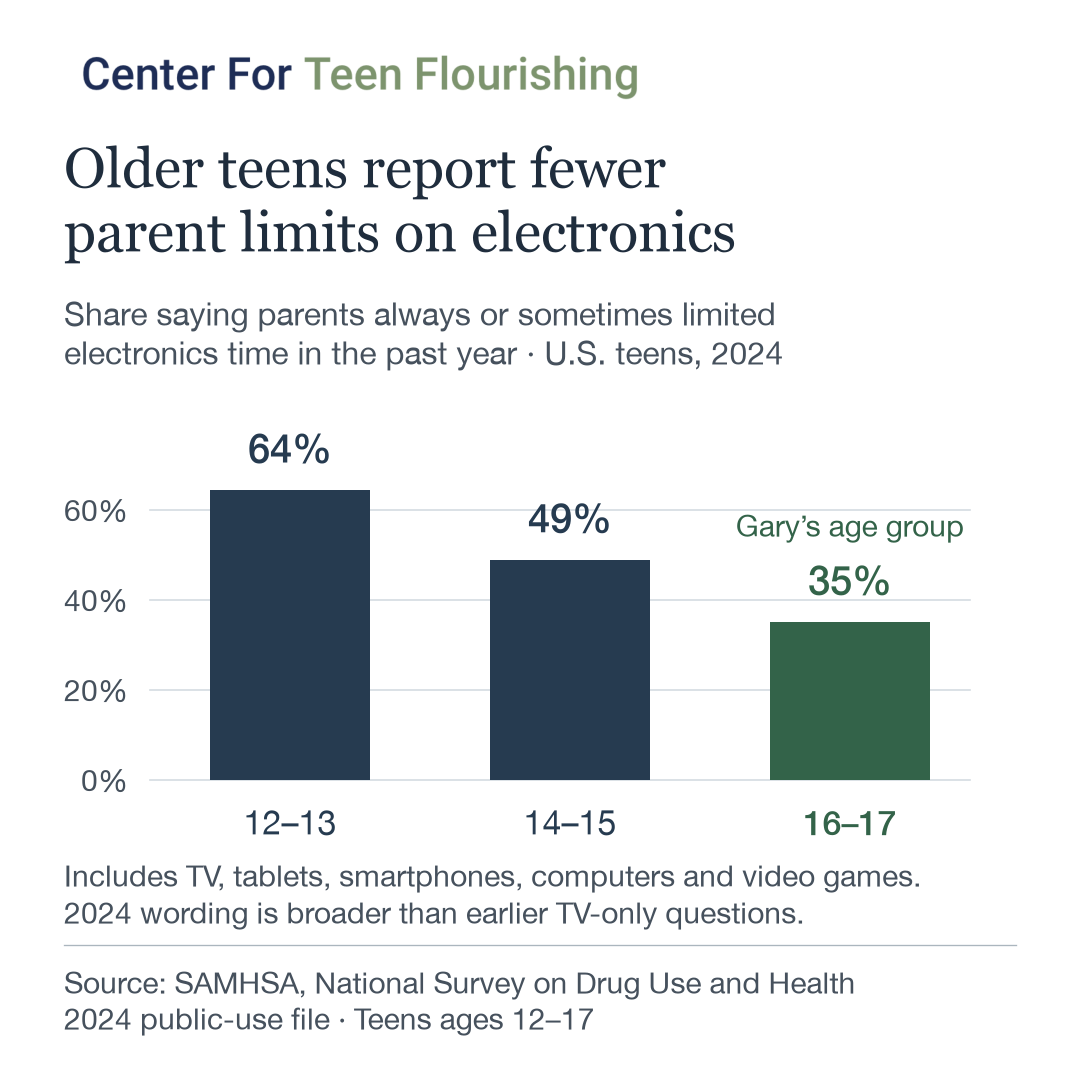
Dad suggested to Mom that they just physically seize the phone every weekend. Mom panicked – she thought it could deeply harm their relationship as Gary was in some ways a young man. “I imagine 25 year old Gary never visiting, being distant.” Older teens are less likely than younger teens to say their parents limit their use of electronics.
My original goal with Gary was to help improve his C grades. I’d coach him on school stuff. We built rapport, joked a lot. So, with encouragement from Mom and Dad, I decided to take on screen time, because it was a major point of friction. Gary wanted to spend less time on his phone, too.
We aimed to reduce it by half. I started by knocking on the Side Door. I didn’t suggest reducing screentime. Instead, I said his weekends seem pretty empty, and he seems to want to fill them, so let’s make a list of things he might do. “Most of the ideas will be things you don’t like or even hate, which is great for my purposes, I’ll be curious about why.”
He was amenable to at least writing out the list.
Here is what it looked like to start:
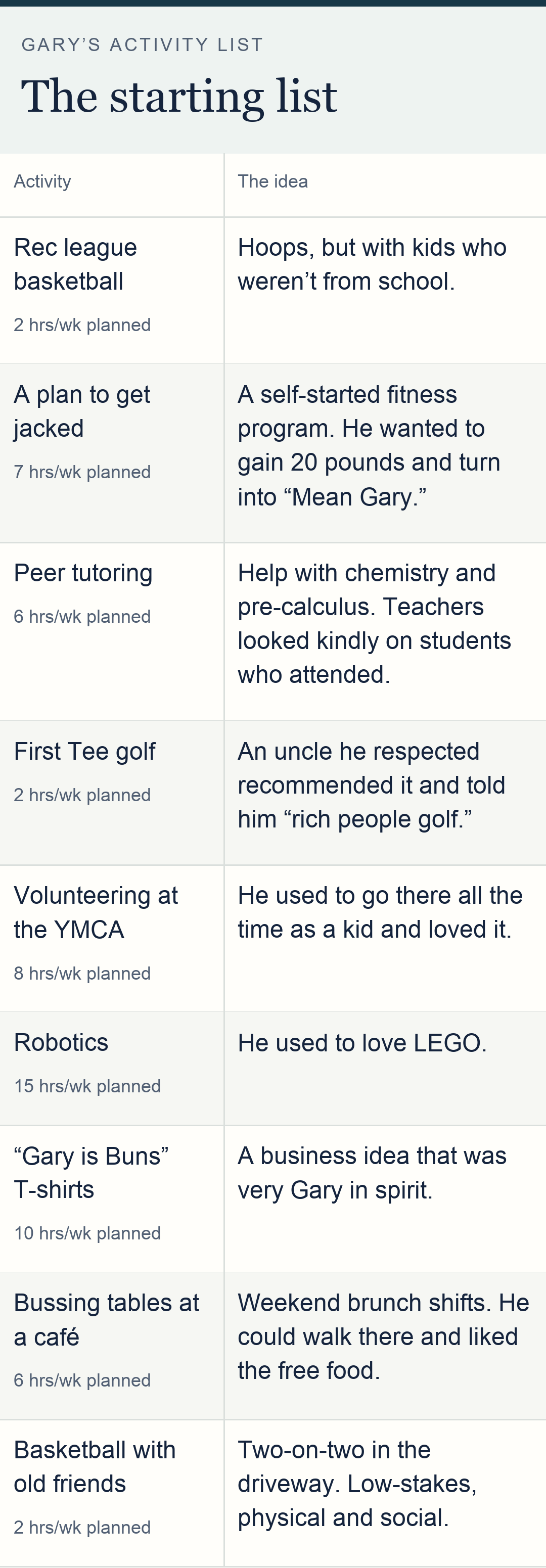
I liked his mix of ideas, and more importantly, I liked how fast we could test each of them. Obviously he was already doing JV basketball.
Here is the same sheet about a month on, with his ratings on it.
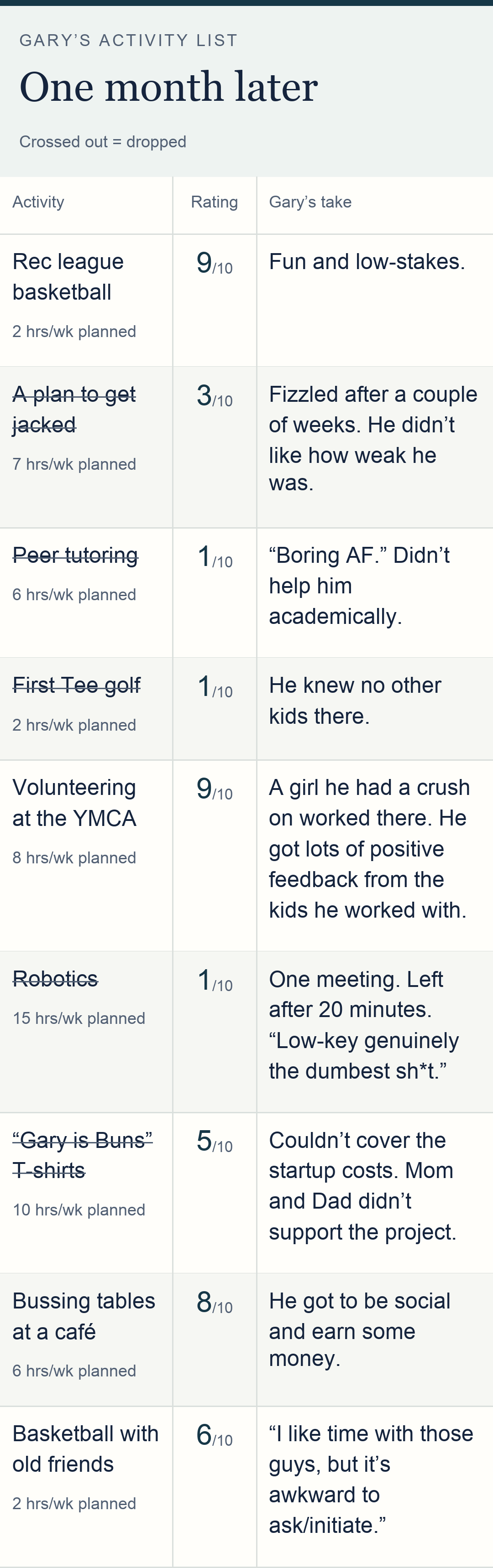
The rec league at the YMCA was smooth – he knew another kid, he played well in his first game, liked the vibe.
He walked into Robotics and left after twenty minutes; they were working through a manual and it felt too much like school.
Golf bombed, too. He couldn’t make solid contact with the ball, and so he was shanking it everywhere. Mostly his shots went about 20 yards in the dirt while other beginners were hitting 150 yards.
The busboy job was straightforward. 9am to 3pm on Saturdays. He liked being paid and feeling busy. The other workers were mostly 25 years or older, there were a lot of Spanish conversations which he didn’t understand, but he didn’t mind.
He was excited to start lifting weights. But he was dissatisfied that he didn’t get noticeably stronger ASAP. I’ll come back to that in the summer when I have more time. I was skeptical, but no need to hammer that point. Let him exit gracefully.
He had a business idea: “Gary is Buns” t shirts, a goofy bit of self-mockery, very much in keeping with Gary’s instinct to lighten things up. But the sales idea hit a wall when he needed money. He wanted Mom and Dad to write a check for the shirts. They wanted him to do $50 of yard work for a neighbor, use that to buy 5 shirts, sell those for $100, and reinvest his way forward. Gary didn’t want to grind. So he shrugged and moved on – a Wantrepreneur as Mark Cuban says.
The surprise “win” was volunteering at the Y. Gary got rave reviews from the managers there. Gary was a smart, funny teenager…perfect to help run the playroom. He could make the little kids laugh but also keep them in check. He had been one of those kids himself once, so he “got it,” and coming back was easy.
He’s also on his best behavior. Serendipity. A girl was his co-lead, and she was…attractive! He was always trying to impress her. Gary was NEVER early for anything. He was early for the Y. (Her volunteer shift started an hour before his.)
In total: Gary had 18 new hours of in-person life: busboy (6), volunteer with younger kids (8), rec basketball (2), 2 on 2 with friends (2).
That’s 18 hours he’s not on screens at all.
Gary and I talked about the new routines. I mentioned he seems very good with kids. He reads a room effortlessly. He knows how to make them laugh, he knows when to push. Could you be the PE teacher? What about a pediatric nurse? What about a juvenile justice worker?
He’s thinking about it.
By then, Gary was spending roughly half as much time on his phone as he had when we started. I think having more going on made his phone less of a draw even when he had time to scroll.
Things are better, he said.
What did Gary’s parents think?
Mom was thrilled. She’d text me, telling me he seemed transformed. He was re-engaged with the world, her dream.
Dad said their relationship had improved from a 2 out of 10 to a 4 out of 10. Big picture, Gary still seemed aimless, not energized by life. He wanted to be an entrepreneur and quit at the first sign of resistance. Robotics, same thing. Golf, same thing.
“What happens when we send him to college? He’ll get stoned every day because no one is around to police him.”
Parents look at the whole picture. Screen time gets mixed in with loneliness, friendship quality, GPA, sports and arts, sleep, chores, backtalk, whether teen holds the door open for someone behind him, and a hundred other signals of how a kid is doing.
It can be worth it to fight-and-win at teen screentime. But often parents describe a battle that, to them, feels like an 11 out of 10 challenge. The peanut gallery will call them weak parents. Fine. But after months or even years, it is what it is. Some parents wonder: is the fight worth the daily conflict, and the strained relationship that could persist into adulthood?
Every kid will have a different list of things they might want to try if a parent pushes Real Life Stuff. What will make any particular at bat successful will vary – whether there’s a cute girl, a cool adult, an early success, or the weather happened to be great that day.
Gary’s life, right now, is better than it was. I hope his dad can tell him that cutting his phone time roughly in half is a victory worth celebrating.
David’s response: Gary reminds me a bit of myself at that age. I’m struck by how the same qualities that get him into trouble become strengths in a different setting. At school, his efforts to lighten the mood frustrate adults; at the YMCA, his humor and ability to read a room make him appealing to the younger children. While reduced screen time is the most visible outcome, I suspect much of his newfound motivation comes from finding opportunities to earn respect, gain independence, and impress someone he likes.
The rec league, the paycheck, and the girl at the Y give him reasons to show up. Even the “Gary is Buns” T-shirt idea makes me wonder how much his self-mockery reflects an awareness of his parents’ disappointment—and how valuable it was for Gary to discover other ways of seeing himself.
I appreciate how Sean let Gary try things, reject some, and exit others gracefully when he couldn't find traction. It gives him room to discover interests without every unsuccessful attempt becoming evidence that he’s incapable. There’s something powerful about a coach or mentor who notices a boy's emerging strengths and helps him build on them while preserving his autonomy.
One case study can’t tell us how well this approach would work for other boys. But it surfaces a useful question for those of us working on digital wellbeing: How to give boys more opportunities to develop their strengths and contribute to others.
Sean Geraghty and Mike Goldstein are co-founders of Center for Teen Flourishing. Most of the dialogue is drawn from Sean’s coaching notes and session transcripts.
I really enjoyed reading this case study! It’s such a thoughtful and nuanced perspective on a thorny issue, revealing how screen time must not be viewed in isolation from the full life of a teen. I’m especially intrigued by the embrace of rec sports, a real affirmation of our recent finding that boys on the margins of traditional school teams want lower stakes options. I’m curious about how the JV coach approached Gary and wonder if more could be done to foster a positive experience there.