

CTRL Panel
Everyone’s looking back at 2025, including the dictionaries.
Merriam-Webster’s word of the year is “slop”, or “digital content of low quality that is produced usually in quantity by means of artificial intelligence.” The Cambridge Dictionary went in a similar direction, choosing “parasocial.”
Both are illusory—an illusion of genuine content, made by humans, and an illusion of genuine relationships, built on mutualism and reciprocity. The “para” in parasocial refers to just this; in the 1956 paper, which coined the term, Donald Horton and Richard Wohl describe a parasocial interaction as “a simulacrum of conversational give and take.”
While they understood parasocial relations as “one-sided… and not susceptible of mutual development,” today’s AI companions are spookily adaptive to our interests.
Later today, we’ll discuss this and more on Substack Live with behavioral scientist Rupert Gill, whose new commentary examines the risks and possibilities of AI companions. RSVP here.
And in case you missed it, yesterday we published an analysis of four different approaches to regulating high-risk technologies like AI companions. “The central question,” David writes, “is not whether we regulate, but how, when, and with what kind of evidence.”
We hope you enjoy today’s digest and the last CTRL Agency for 2025—we’ll catch you in the new year!
The Feed
Findings
Young people taking risks, buying meme stocks
A recent whitepaper by the Financial Industry Regulatory Authority (FINRA) finds that 62% of young Americans feel that they need to take risks in their investments to reach their financial goals. The report also found that 16% of men (vs. 9% of women) have purchased a meme stock, consistent with prior research looking at who participates in meme investment frenzies.
More evidence that loot boxes predict problem gambling
In the last edition of CTRL Agency, we highlighted a longitudinal study showing that gambling-like elements like loot boxes predict future real-money gambling; the next day, a large-scale cross-sectional study of Italian students (ages 15-19) in Lancet bolstered the case that its loot boxes, not just gaming, that tracks harms: teens spending more than €5/month on loot boxes had almost 5 times higher odds of problem gambling.
Policy & News
Should we stop talking about sex addiction?
Last month, the editors of The Journal of Sexual and Relationship Therapy recommended that clinicians abandon the concepts of ‘sex addiction’ and ‘porn addiction’, as “concepts that lack sufficient scientific evidence”. They also insisted that the term ‘compulsive sexual behavior disorder’ (CSBD) only be used when all ICD-11 criteria are met (A 2024 study shows that half of clinicians would diagnose CSBD even in cases where there is no evidence of loss of control—one of the ICD-11 criteria).
From our DMs:
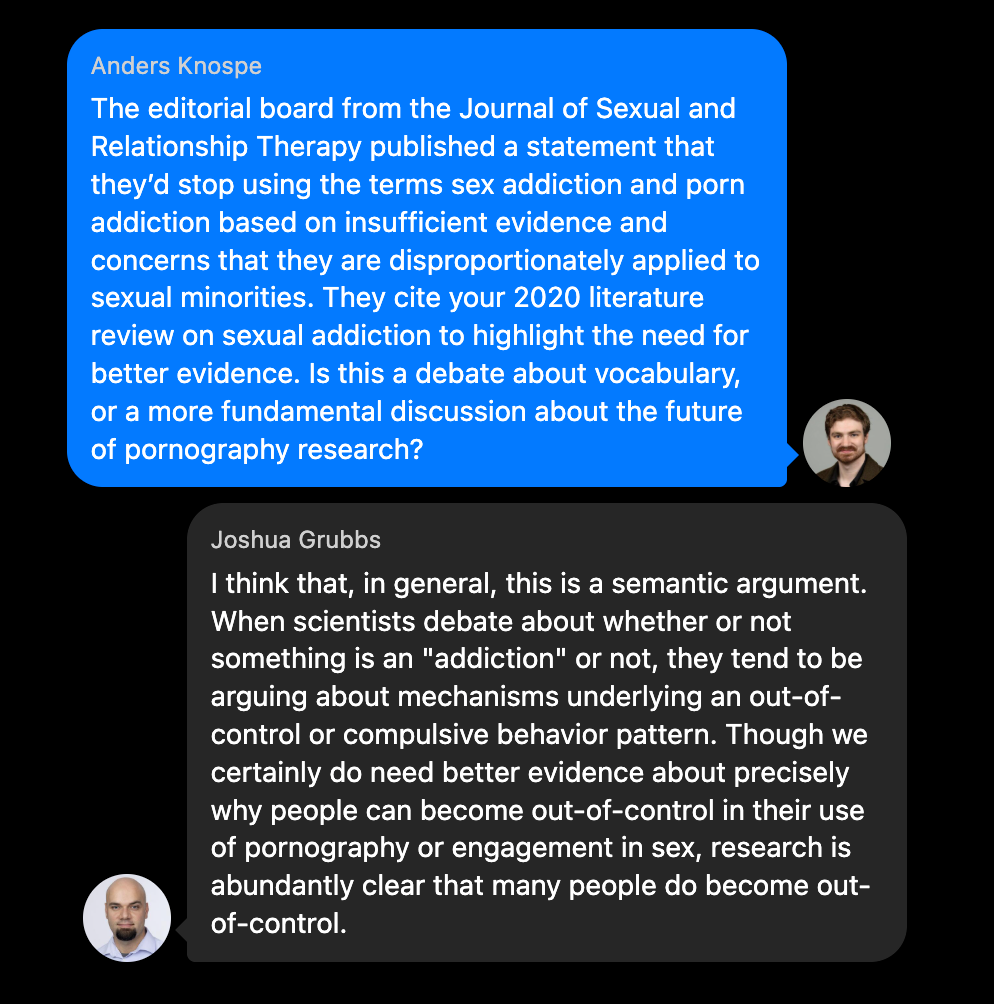
Sexual addiction 25 years on (Grubbs et al., 2020) maps the ongoing debate among researchers and clinicians over “sex addiction” and “porn addiction,” against the backdrop of increasingly ubiquitous online pornography and a rapidly growing research literature.
The New York Times on crypto casinos
A recent New York Times investigation takes aim at the streamers and celebrities making millions promoting crypto casinos, hitting many of the same notes as a recent video essay by YouTuber Coffeezilla. The piece draws similar conclusions—especially around how many affiliate creators are nihilistically aware of the harm they’re contributing to.
A Social Finance report found that children and young people who follow gambling content-creators are 20x more likely to participate in high-risk investment activities like crypto trading. Still, we’d like to know more about the causal mechanisms at play here: what are the pipelines into crypto casinos?
Takes
The ‘Parent Test’ for prediction markets
Referencing the debate about whether prediction markets are a form of betting, Dustin Gouker offers a simple test: “What would you tell your kids about prediction markets, if you had to have a conversation about it? If you’re telling them that what’s happening at prediction markets isn’t betting in any way, shape or form, I’d argue that you’re lying to them.”
What else we’re reading
Trump signs AI executive order pushing to ban state laws - The Verge
America’s Betting Craze Has Spread to Its News Networks - The New Yorker
NFL expresses concern to Congress over rise of prediction markets - ESPN
College campuses have become a front line in America’s sports-betting boom - The Economist
Porn Is Poisoning Our Culture - City Journal
Americans Increasingly Say Sports Betting Is Bad for the U.S. - Morning Consult
Poll shows Americans’ growing concern over influence of sports gambling - Washington Post
Events & Funding Opportunities
FTC Workshop on Age Verification Technologies | DC | Jan 28, 2026
International Conference on Gambling & Risk Taking | Las Vegas, NV | May 26-28, 2026 | Call for abstracts closes January 23rd.
National Conference on Gambling Addiction & Responsible Gambling | Nashville, TN | July 22-24, 2026 | Call for presentations closed.
What did we miss this week? Do you have an upcoming conference or study we could feature in the next edition? Are you a researcher studying pathways into crypto casino usage? Let us know at bmonline@substack.com, or shoot me a message here.
If you haven’t already, please subscribe to stay up to date on Boys & Men Online.
And share!
You guys are unwilling to call out the internet pornography industry for what it is: deliberate mass sexual abuse of the teen boys consuming it, and a deliberate attempt to demoralize them, and turn millions of young girls out. Oh, and misclassifying internet porn as free speech terrorized millions of parents who cant keep their curious sons away from it.
That's why this essay has two likes.