


Introduction from David: In a recent edition of CTRL Agency, Anders Knospe highlighted a new study examining how state age-verification laws affect pornography use. We wanted to give the study a fuller treatment by inviting two of its authors, Matthew Brown and Emily Davis, to summarize their findings, limitations, and implications for policymakers. As we noted in a recent landscape scan, pornography policy is evolving faster than the evidence base. This paper—coauthored with Devin Pope—is a valuable example of policy-relevant research that uses an innovative study design and unusually detailed browsing data to measure not only whether regulation changes behavior, but also how users and platforms adapt in response.
By Matthew Brown and Emily Davis
Half of all U.S. states have implemented laws that require pornography sites to verify users’ age. In response, the largest porn website, Pornhub, blocked access to all users in states with such laws. Pornhub is one of the top 10 most visited sites in the world, receiving over three billion visits globally each month. So, when it disappears, do people stop watching porn—or do they find workarounds?
As academic economists who work on public policy, we thought this question was worth answering. These recent laws are some of the most ambitious online regulations in U.S. history, and other states, such as New York and Pennsylvania, are debating whether to implement their own versions. But the overall impact of these laws is not obvious. It’s plausible that some users are deterred from viewing porn by Pornhub’s access restrictions, but news reports have highlighted that others get around the restrictions by using VPNs or migrating to other porn sites that did not comply with the laws.
Using anonymized browsing data from more than 500,000 devices, we find that age verification laws do reduce porn-site viewing. But the effect is modest. Total time spent on porn sites fell by roughly 10% among the adult devices in our sample. Many users appear to have circumvented restrictions with VPNs or shifted to noncompliant sites that did not verify age.
Our findings suggest that age verification laws can reduce access to porn, but their impact depends heavily on enforcement, platform compliance, and how easily users can move to less regulated corners of the internet.
What we measured on 500,000 devices
We purchased anonymized internet activity data for over 500,000 mobile devices and computers from 2022 to 2024.1 With this data, we could observe every time a device visited a website and how long that visit lasted, along with some demographic information about the users of the devices.
While our data is much more detailed than data used by previous studies, it is not perfect. Crucially, it is not a representative sample of U.S. porn browsing in terms of demographics and device types. We also do not capture website visits from private browsers like Google’s Incognito mode.2 Most importantly, our data only contains devices owned by adults, even though the laws are targeted at minors. Therefore, our research directly measures how adults responded to the laws, which might provide indirect insights into impacts on kids and teens.
How did the laws affect porn viewing?
To measure the effects of the laws, we studied whether trends in internet activity changed in states right after they passed the laws. In the graph below, the “0” point on the x-axis represents the week that Pornhub blocks users in states where the laws took effect. Unsurprisingly, we see that time spent on Pornhub fell dramatically after the site blocked users.
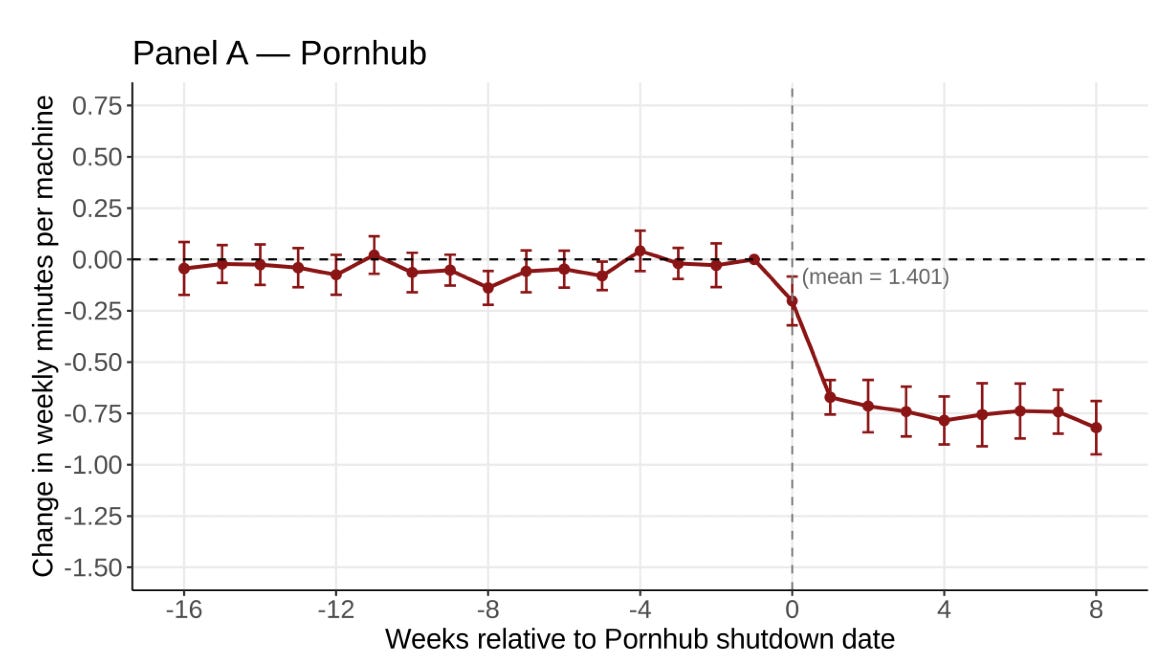
What’s more interesting is that some users continued to visit Pornhub even though the site should have been blocked in their state. Time spent at Pornhub fell by about 0.75 minutes per device per week, but that decline only eliminated about half the time people were spending at Pornhub before the shutdown. The most plausible explanation for so much continued use of Pornhub is substantial VPN-based circumvention.
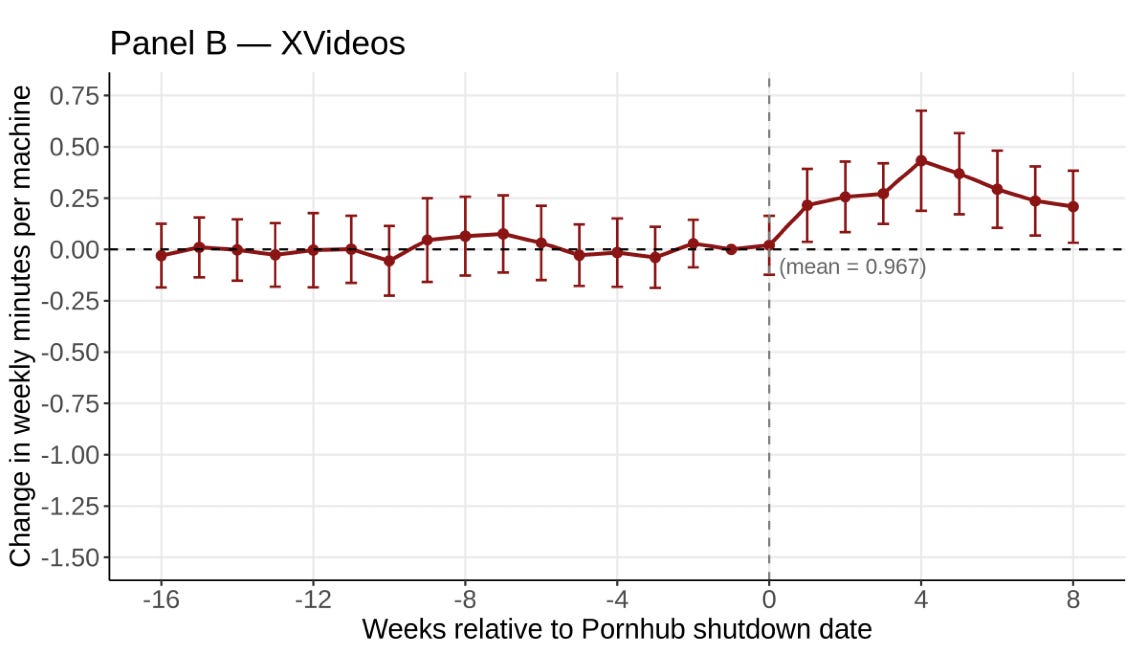
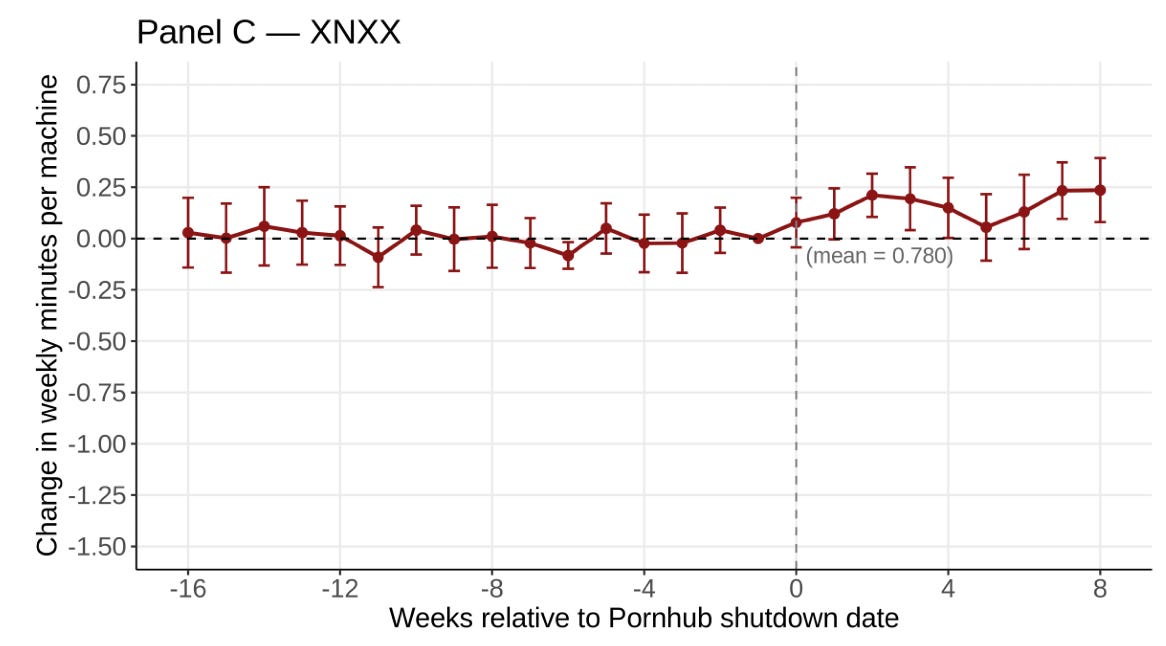
VPNs are not the only way to continue watching porn in states with age verification laws. While Pornhub chose to block access, other popular pornography sites (XVideos and XNXX) have continued operating without verifying users’ age.3
We found that time spent at those websites rose immediately after the laws passed, which is evidence that people were switching from compliant sites to noncompliant sites. Some have argued that this kind of substitution is a downside of regulation, as Pornhub has taken steps to eliminate illegal content (such as content related to nonconsensual activity or child sexual abuse), while many of its noncompliant competitors have not.4
The next graph shows how the laws affected total time spent across all of the 200,000+ porn sites in our data. Despite the presence of VPNs and noncompliant alternatives, age verification laws noticeably reduced porn viewing for our sample of devices.
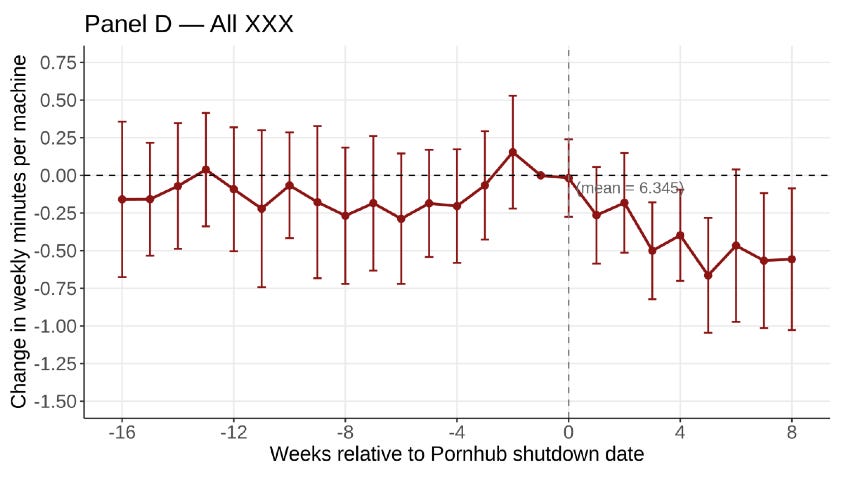
Quantitatively, we estimate that age verification laws reduced total time spent at porn sites by roughly 10%.
Our final graph breaks down time spent at the top 25 porn websites before and after laws were passed by type of website (compliant or noncompliant), to illustrate the importance of the various channels that we measure. For every 100 hours spent at top porn sites before restrictions, about 50 hours remained accessible at noncompliant sites that never restricted access, 30 hours persisted through VPN-based circumvention, 10 hours shifted from compliant sites to noncompliant sites, and 10 hours were no longer spent on porn sites.
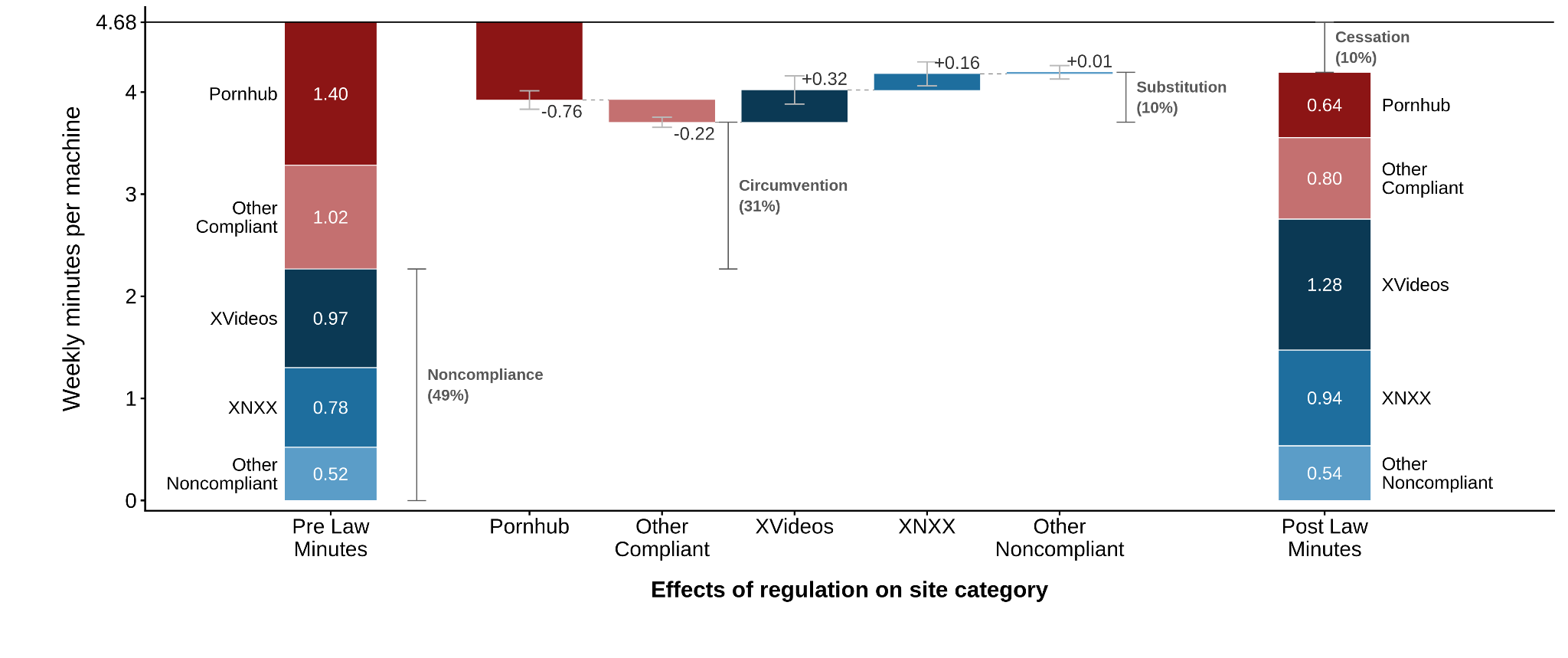
All of these results apply to adult users because we do not have data on minors. One could imagine that the laws’ impact on porn viewing for minors would be larger (young people may be less familiar with noncompliant sites than adults, and some VPNs require credit cards) or smaller (young people may be more familiar with VPNs than adults). We tried to use some patterns in our data to learn about whether impacts on minors were likely to differ, but our tests were inconclusive.5 Overall, though, the effects – modest reductions in porn site viewing, muted by VPN usage and switching to noncompliant sites – appear across many demographic groups within our adult sample.
Broader implications
Whether age verification laws are a good idea depends in part on whether and how they affect porn viewing. People disagree about age verification for many reasons: free speech, privacy, parental authority, child protection, and views about pornography itself.6 Our study does not settle those debates. It answers a narrower question: what happened to porn-site viewing after these laws took effect?
Debates about online regulation extend beyond porn. Policymakers around the world have attempted to regulate activities like social media use and video games. There are many ways to design such policies, and whether the regulations achieve policymakers’ goals depends on how platforms and users respond to these laws.
Platform noncompliance is a major factor limiting the impacts of current regulations for online pornography. Even if policymakers reduced VPN-based circumvention (for example, through device-based age verification), it may still be possible for users to switch to noncompliant sites based in jurisdictions where enforcement is difficult. In other areas of online life, there may be fewer plausible alternatives. For example, in contexts like social media, network effects tend to create markets with a few dominant platforms, and regulators may be able to force all of them to comply. As policymakers design future regulations for online activity, we hope they will consider the viability of enforcement and how platforms and users are likely to respond.
Other work on age verification laws includes Lang et al. (2026), Agarwal et al. (2026), and Spencer (2025). Much of what we find is qualitatively consistent with this earlier work.
This fact means we are almost certainly underestimating the amount of pornography users are viewing. We do not think that it invalidates our estimates of the effects of age verification laws, because we have no reason to think that people use private browsers more after a law takes effect – private browsers do not allow users to circumvent local access restrictions. We provide some evidence on this issue in the paper.
These sites likely chose not to comply because of the legal uncertainty around age verification laws and the practical difficulty of enforcing them. More public-facing companies like Pornhub may have complied to protect their image, while less well-known sites like XNXX and XVideos faced less reputational risk and kept operating despite potential legal consequences. More recently, states such as Florida have sued XVideos and XNXX for noncompliance. However, during our analysis period, these sites remained largely free from legal scrutiny.
This issue comes up often in debates about the regulation of so-called “vice goods.” For example, a prominent argument for the legalization of sports betting is that when sports betting is prohibited, people turn to offshore websites or other forms of underground gambling, which might be more harmful than a regulated sportsbook. It is typically hard to measure these effects because data on this kind of quasi-legal activity is hard to come by. Our analysis provides a case study demonstrating the importance of substitution to unregulated alternatives for online regulations.
We conducted two tests, and the results pointed in opposite directions. First, we looked at the behavior of 18-24 year olds – the idea is that this group might be similar to older teenagers. The evidence here was consistent with a smaller reduction among minors: 18-24 year olds’ porn viewing fell by less than that of older adults, mostly because they engaged in more VPN-based circumvention. Second, we studied computer browsing in households with children – the idea is that some of the porn website viewing on computers in households with children likely arises from children browsing on family computers. The evidence here was consistent with larger reductions among minors: porn viewing declined more among households with children present than without.
For example, some oppose the laws on the grounds that they infringe upon First Amendment rights. People also disagree vociferously about whether porn viewing should be discouraged at all, though there is broad consensus about the negatives of minors viewing porn: roughly one third of Americans consider pornography morally acceptable, and a 2023 poll found that 83% of registered voters support a national age verification mandate for adult content sites.
Did fewer boys get traumatized and embittered and have their lives ruined as a result of these laws? At least we’re showing boys we care now, and not telling them “everyone looks at porn it’s no big deal” like gaslighting vampires.