

Five months ago, we launched Boys & Men Online to bring evidence to a debate where legitimate concerns had outpaced nuanced analysis.
The commentary had become overheated. Young men were either being algorithmically radicalized into violent woman-haters or zombified into degenerate gamblers, gamers, and porn addicts.
We thought there was a need—and an audience—for calm, rigorous, and open-minded analysis.
At their best, online tools are a “bicycle for the mind” — extending agency, connection, and purpose. But at their worst, they become slot machines of stimulation, hijacking otherwise healthy drives for mastery, intimacy, and achievement, and redirecting them into compulsive, often solitary loops.
I’ll admit that I have been tempted by the crisis framing myself. Alarm travels faster than nuance. But the reality is more complicated: Boys and men also find useful information, fun, skills, romance, and genuine friendships online.
How can researchers, platform designers, and policymakers harness those benefits while addressing the harms? The real task is to understand when online life becomes a tool for agency and connection, and when it becomes a trap.
What We’re Learning
I want to highlight four lessons from our first five months:
Prediction markets, everywhere
In February, we hosted a webinar on the future of online sports betting with three industry experts. They all pointed to prediction markets as the big disruptor. They were right.
Congress has introduced over 20 bills, resolutions, and amendments related to prediction markets. Kalshi just raised another billion at a valuation of $22 billion, and later this month, the Senate Commerce Committee will hold a hearing on sports betting — including on prediction markets. Over ten states are involved in lawsuits with prediction markets, and the Supreme Court will likely decide whether federally regulated prediction markets preempt state gambling laws.
Whatever the courts decide, prediction markets won’t be the last innovation in online gambling. Gamified finance will continue to blur the line between investing, gambling, and entertainment.
Our position is not prohibition, but commonsense regulation. We developed a policy framework of specific solutions to reduce harms while preserving fun and innovation. We are fortunate to have Jonathan D. Cohen leading this work with support from AIBM’s gambling research and policy fellow, Isaac Rose-Berman. We have much more in the works, as I describe below.
Porn, intimacy, and the return of romance
Teenage boys, aware that any message could be screenshotted or that a clumsy approach could go viral, may be reluctant to take romantic risks. Meeting one’s sexual needs has never been easier online, while pursuing real relationships feels more perilous. Fewer than half of high school seniors today report they are dating, down from more than 80% in the 1990s.
It’s time for a real conversation about porn, as I wrote in a commentary at AIBM. We also need better evidence, as shown in our synthesis of the latest research on pornography’s impact on boys and men.
Last month, we hosted a webinar with the authors of that evidence scan. And next month, we’ll convene more than 25 of the leading pornography researchers to develop a forward-looking research agenda. We aim to identify the most urgent evidence gaps on pornography’s impact — and on the broader decline in dating.
There is no reason to shame young men for seeking sexual stimulation. But we should have better evidence on whether it is displacing human connection.
Gaming (in moderation) can be fun and healthy
Gaming is often treated as if it were one thing. But a cooperative game with friends is not the same as a solo game with addictive features. An hour of play after school is not the same as all-night avoidance of life’s troubles.
Over the last 15 years, boys and young men more than doubled their average time per week spent gaming, observes Claire Cain Miller. For most teenagers, the perceived benefits outweigh the harms:
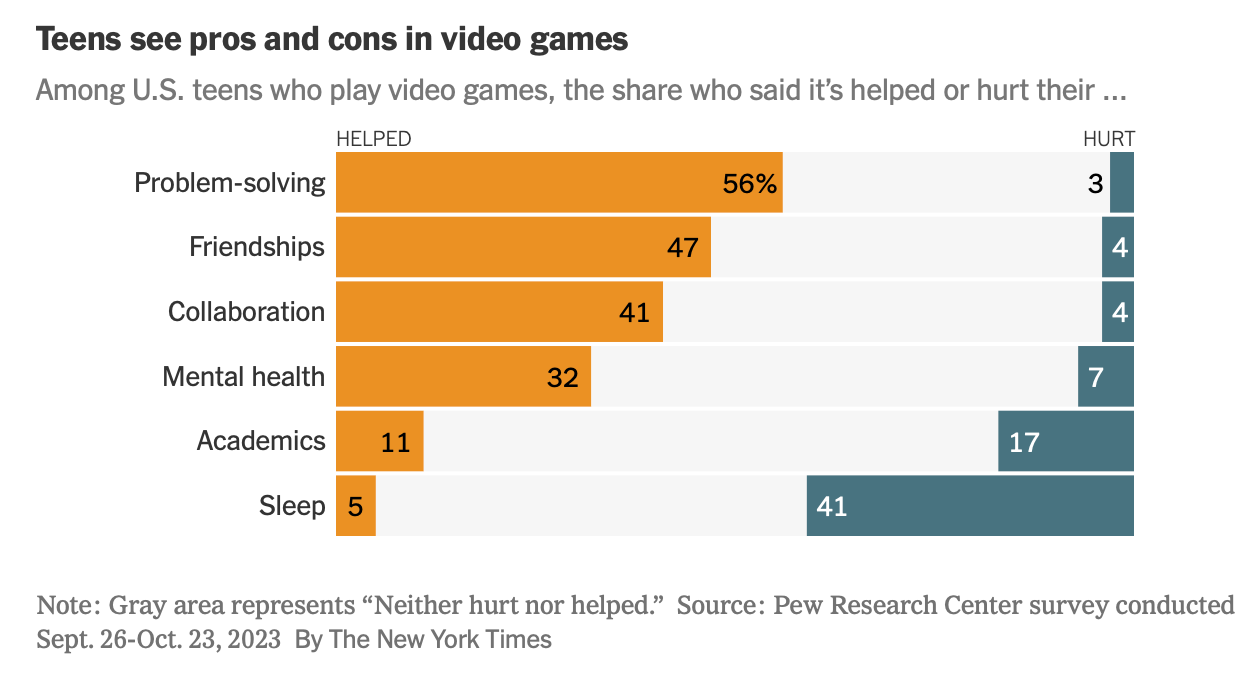
Annie Maheux notes that boys are especially likely to use gaming for connection while Jason Nagata points to recent evidence suggesting that video gaming may strengthen cognitive and executive functioning in adolescents and young adults.1
Gaming is neither good nor bad. We need more specific research about which games, for which boys, and under what conditions, as my colleague Anders Knospe raised in a recent research digest.
If you’re a parent concerned about your child’s gaming, check out my discussion with Kruti Kanojia and Jim Festante for some practical tips:
An FDA for high-risk technologies
My first piece for Boys & Men Online argued for an FDA-like approval process for high-risk technologies like AI companions.
We do this for medicine, cars, and food, but high-risk digital products are used by millions of children and adolescents without any safety screening.
There is a better way to regulate high-risk technologies than bans or legal liability. A pre-approval process would create incentives for companies to design for flourishing from the start. It would also provide researchers with better data to assess the likelihood of potential harms before products reach massive scale.
When I first wrote about the idea, I thought it was a pipe dream. But the rapid advancements of AI have changed the game.
The White House is considering an executive order to evaluate leading AI models through an FDA-like approval process. Senators Hawley and Blumenthal proposed an evaluative approval process housed within the Department of Energy. Senators Warren and Graham proposed a new federal agency to “regulate digital platforms, including with respect to competition, transparency, privacy, and national security.”
AI created the urgency, but the precedent could then extend to other high-risk technologies, and offer a smarter approach than all-out bans or litigious liability.
So what comes next?
We’ve got a lot in the works:
May 20: A Substack Live conversation with Sam Pressler and Soren Duggan about their new interactive report, Nobody to Call, an examination of male disconnection. (Register here.)
May 27: A webinar in partnership with the Psychology of Technology Institute on new tools and methods to study digital interaction. (Register here.)
June: Kicking off a new research project on how young men define a good life, how it shows up in their daily lives, and what gets in the way.
June: A webinar with kyla scanlon, German Lopez of The New York Times, and Matt King of Fanatics on gamblification and financial nihilism.
June: A podcast with Anna Lembke about dopamine, reward loops, and addictive design.
July: A synthesis of new directions for research on pornography use.
And more: Anders’ biweekly CTRL Agency digest on digital technology in the lives of young men, our first creators council meeting, and profiles of our partners and graduate student fellows.
Thank you for being with us from the beginning. We are trying to build a space for clearer thinking about a noisy subject. We want to take the harms seriously without surrendering to panic, and take the benefits seriously without drifting into rose-tinted optimism.
Our digital lives are too vast to be simply good or bad. Feature by feature, we can address the harms while harnessing the benefits.
Funding for Jason’s work was provided by the National Institutes of Health and Rise Together, a donor-advised fund sponsored and administered by National Philanthropic Trust and established by Richard Reeves, founding president of the American Institute for Boys and Men.
The line about alarm traveling faster than nuance hit home. I mentor boys in Philadelphia, and the boy in front of me is almost never the scary headline version. The real ones are more mixed, and a lot more reachable, than the panic makes them sound. Glad someone is taking the harms seriously without the panic.
David--Thanks so much for the very helpful and important work that you are doing!